
If you had opened any field guide or distribution map before 2023, you would have found the New Guinea Jumping Mouse (Lorentzimys nouhuysi) sitting neatly along the Central Cordillera of New Guinea, and nowhere near the Bird’s Head. This is the story of how a small, bouncing, very charismatic rodent turned up where it was not supposed to be, and of what we have learned about it since.
A mouse that doesn’t fit the map
Lorentzimys is a strange little murid, the only member of its genus. Jentink described it in 1911 from the Lorentz River, in what is now Papua province, at about 400 m. Every standard reference since has placed it along the Central Cordillera and the hills to the south. Mammal Species of the World gives records from the northern slopes of the Snow Mountains east to Mt Dayman, at the far end of Papua New Guinea, plus the Torricelli Mountains, at 30–2,700 m, and adds “limits unknown”. The Handbook of the Mammals of the World says much the same, with 80–2,700 m. Museum specimens follow the same pattern: none of the records we could find in GBIF came from the Bird’s Head, apart from an iNaturalist photo from our own 2024 tour in the Arfaks. Some older authors treated the long-furred highland form alticola as a separate species, nobody has yet done a proper genetic review of the genus, and the late Ken Aplin suspected that L. nouhuysi could hide several undescribed species.
What it is not supposed to do, at least on paper, is live in the Vogelkop.
2022: the one that got away
My first encounter was inconclusive. In 2022, at Malagufuk, in the lowland forest near Sorong, something small went bouncing across the trail in front of me. I was convinced it was a jumping mouse, but I had no photo, and a mouse without a photo is not a record. The only person I told was a good friend of mine, Venkat Sankar, a fellow mammalwatcher with a huge passion for these animals. We agreed it was worth keeping an eye out for, and let it rest.
Malagufuk, June 2023
In June 2023, during the first dedicated mammalwatching tour to West Papua (with Jon Hall, Charles Foley, Venkat Sankar, Ian Thompson, Juliana Senawi and Nils Bouillard), we went back to Malagufuk for five nights. The forest there is lowland and swamp forest at around 50–100 m. Walking the trails between 7 pm and 1 am with thermal scopes and torches, we finally got it.
The first animal was scampering back and forth at speed along the wooden handrail of the boardwalk, with a curious, almost reptilian gait: legs splayed, belly low. We watched it for a long time and photographed it at length: broad head, pointed ears, extremely long whiskers, greyish-brown upperparts, pale greyish-white underparts and a long, plain grey, tufted tail clearly longer than the body. Everything fitted the description in Flannery’s Mammals of New Guinea, and Venkat confirmed the identification on the spot: Lorentzimys, 100%.
Two nights later we found a pair on the open floor of streamside forest. These were a surprise: their upperparts were distinctly reddish-brown rather than grey. Both colours are mentioned in the literature, but we had never heard of them living side by side. When disturbed they did exactly what the common name promises: they shot away in near-vertical hops of up to 30 cm, flattening their bodies in mid-air, and one then ran straight up a thin sapling. Very little has ever been written about how this animal actually moves, so it was a joy to watch.
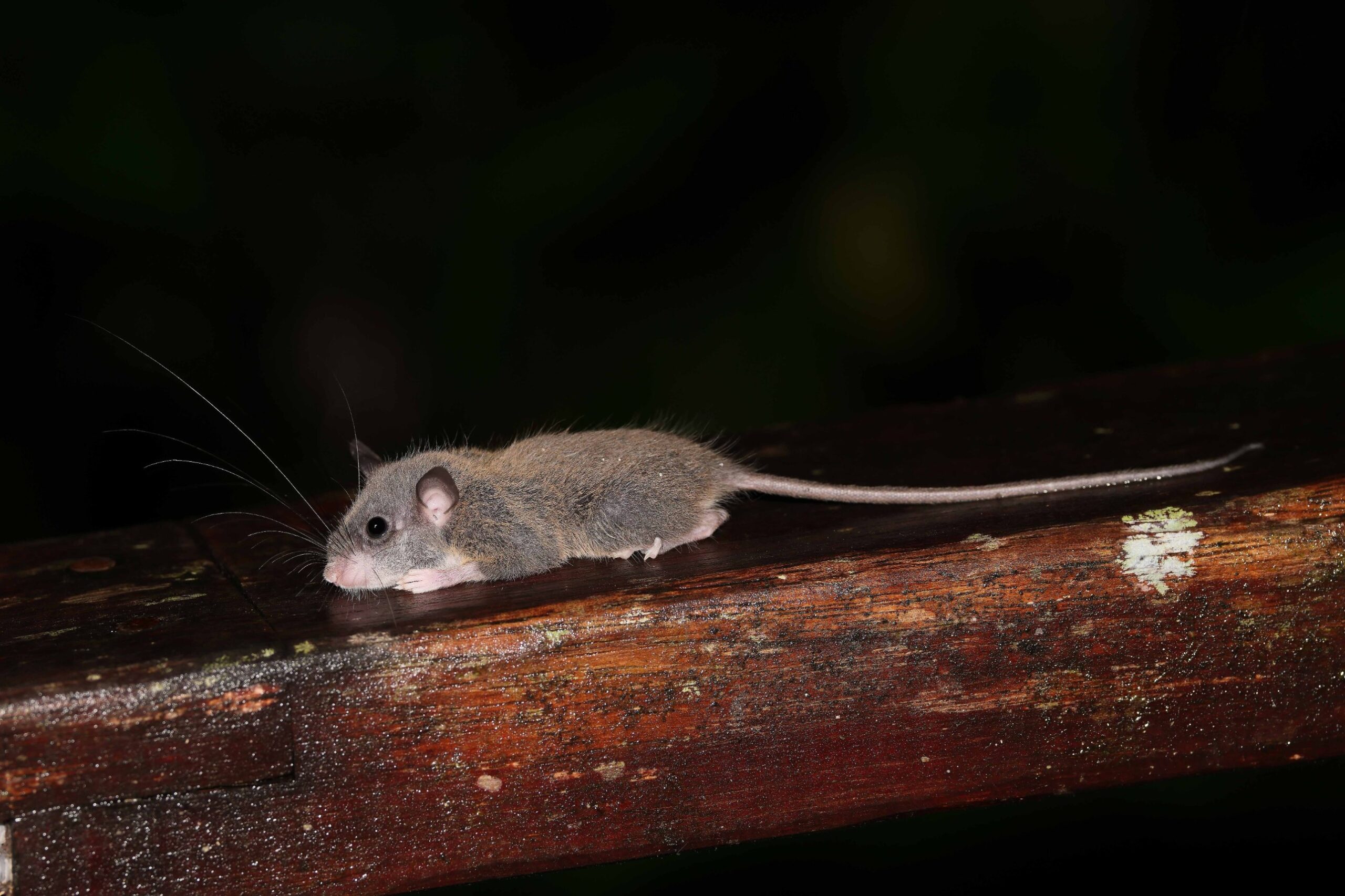
In all we had three sightings of four individuals in five nights, which suggests the species is not rare there at all. It was one of the highlights of a trip full of highlights.
Telling the scientists
Back home, we shared the photos with a couple of people who know New Guinea’s rodents far better than we do. Their answer was clear: the genus had never been recorded scientifically from the Vogelkop Peninsula. They know who they are, and the emails are all still in my inbox.
Venkat drafted a short note on the record, and we all chipped in. Malagufuk lies some 700 km north-west of the westernmost published records, on the northern slopes of the Snow Mountains, and given how many endemic vertebrates the Vogelkop holds, we suggested the population could well be something new. Everyone agreed it deserved to be published. Then, as often happens, field seasons, tours and life got in the way, and the paper was never finished.
Filling in the map
I didn’t stop looking, though, and with every trip the picture has become clearer:
- Malagufuk (Sorong Regency): lowland and swamp forest near sea level. First glimpse in 2022, confirmed in June 2023 with four animals in five nights.
- Arfak Mountains: first found there on the 2024 tour, with excellent photos and video, and since then up to about 1,800 m. This is a long way up from the swamp forest of Malagufuk.
- Klalik: the village where we run the echidna ecotourism project. On the 2024 tour we recorded six animals there, and in May 2026 I photographed one peering out of a hole in the forest floor at around 300 m.
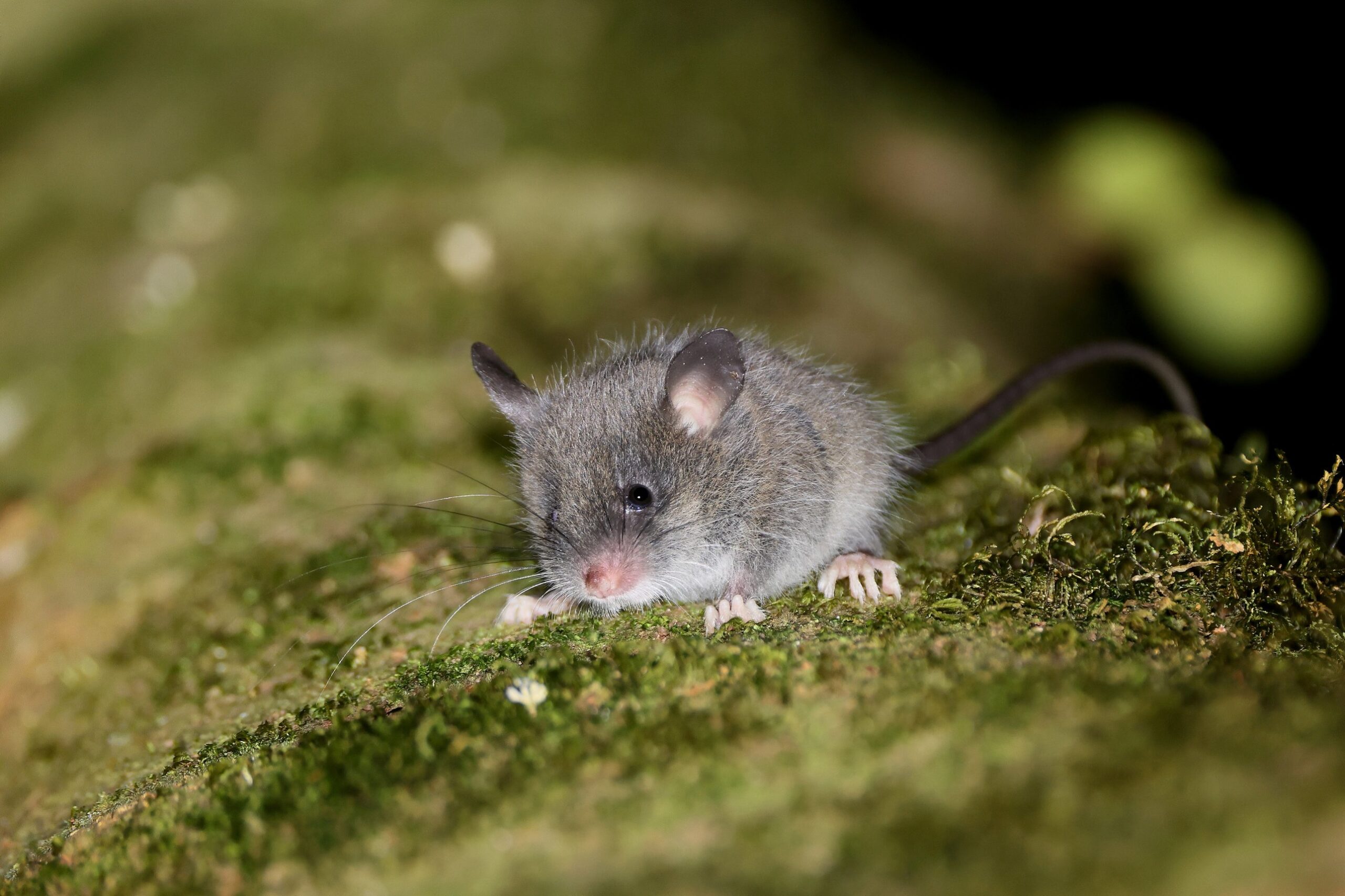
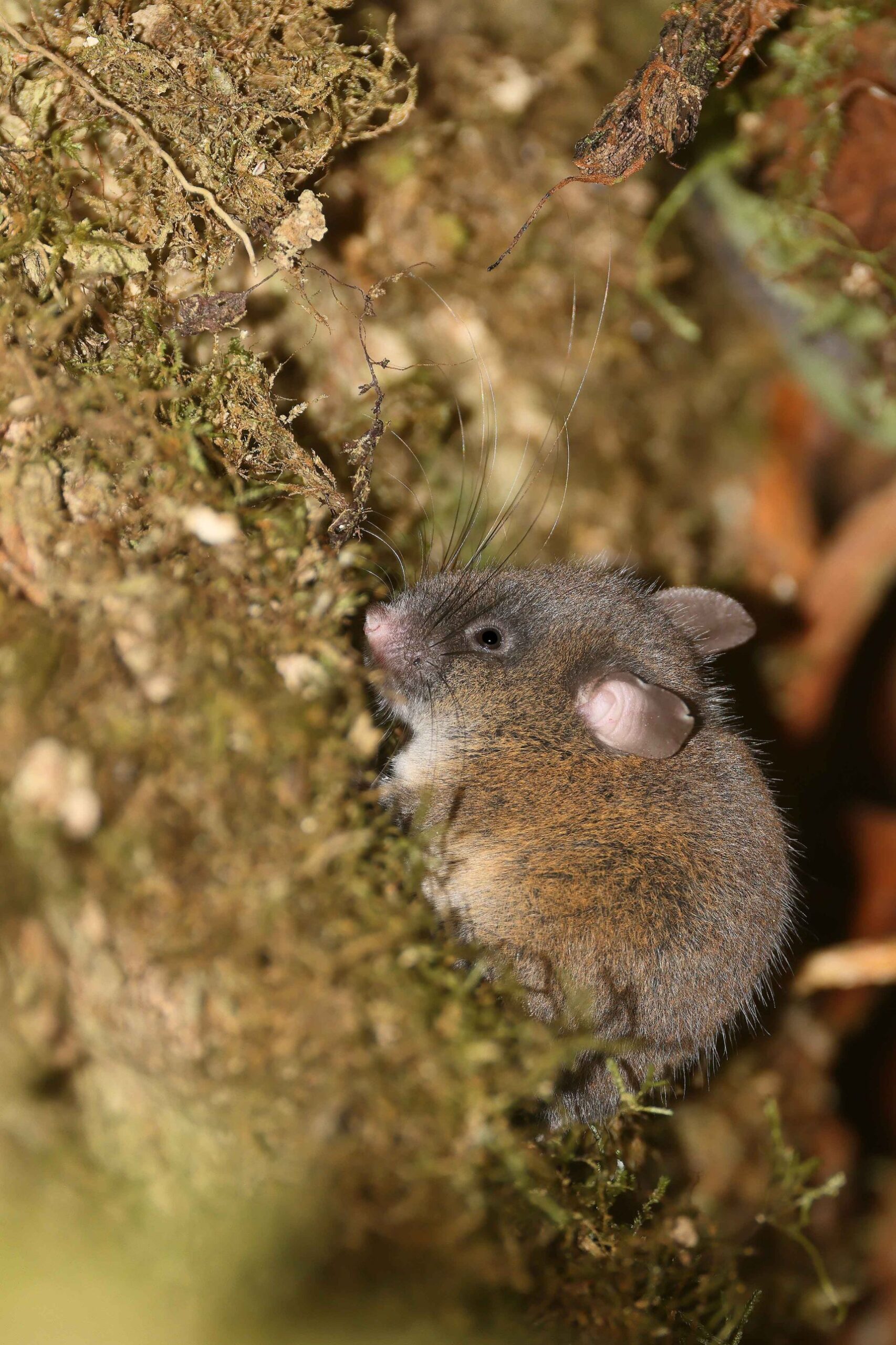
- Papua New Guinea: in May 2025 I saw and photographed it high in the Owen Stanley Range, at around 2,000–2,500 m, well inside its known range, which makes a very useful comparison (see photos below).
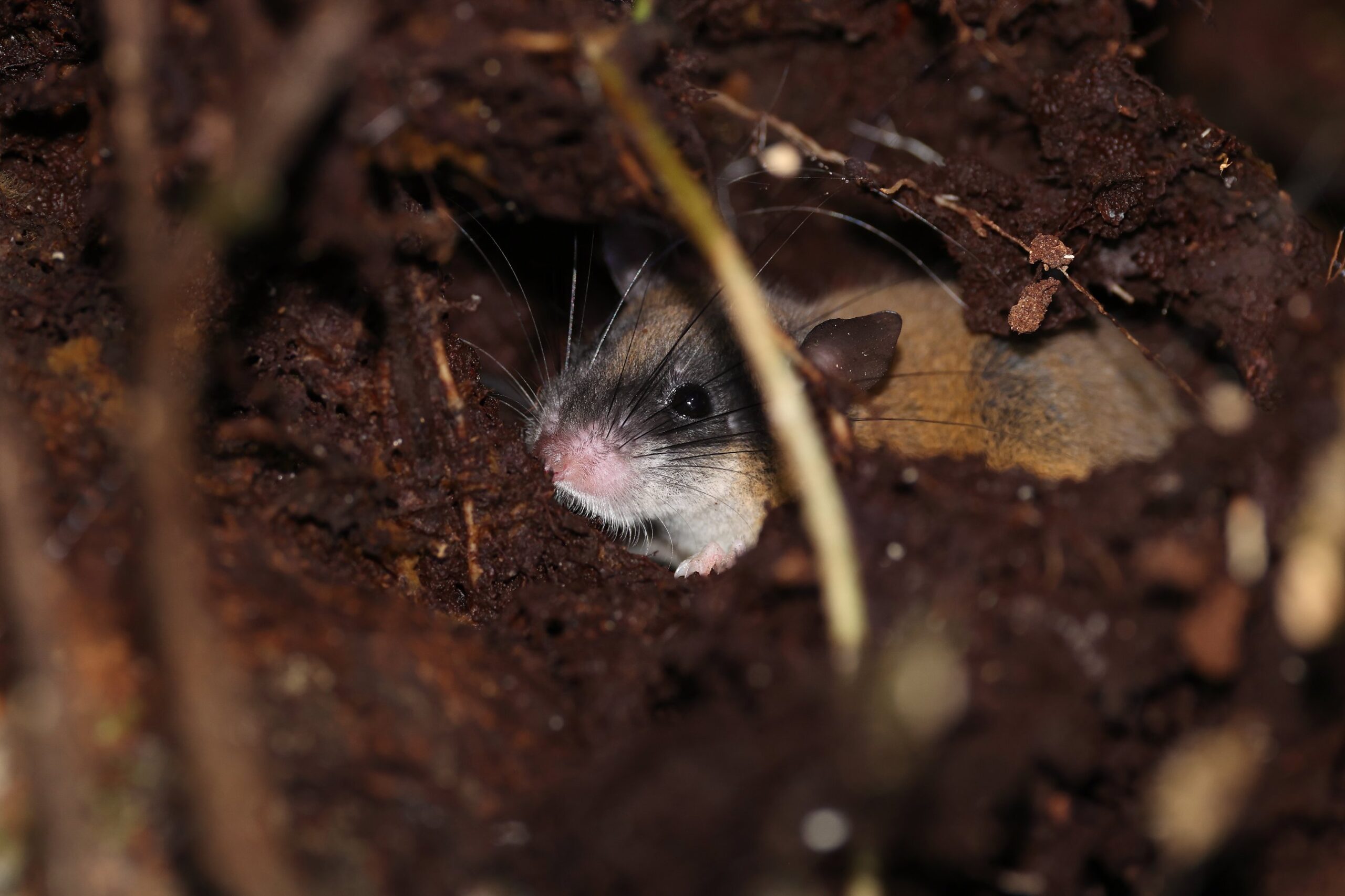
So the Vogelkop population is not a one-off. The jumping mouse is spread across the peninsula, from lowland swamp forest near sea level to well up in the Arfak Mountains, and in some places it is easy to find on a good night.
One species, or more?
That is now the real question. Is the Vogelkop jumping mouse the same animal as the one along the Central Cordillera, or a separate, undescribed species? Geography points one way: the Bird’s Head is a hotspot of endemism, separated from the main range by the lowlands of the Bomberai and Wandammen area. The colour variation we saw, grey and reddish animals living side by side, adds another layer. But geography and photos alone are not enough: only a proper taxonomic study, including genetics and comparison with populations from across New Guinea, will settle it. That work is still to be done, and we would love to see it happen.
There is already a precedent for splitting the genus. Highland animals were once described as a separate form, alticola: long, soft fur instead of short and crisp, greyish rather than white cheeks, black instead of white hairs on the tail, and less wedge-shaped ears. Several authors treated it as a full species (Tate 1951; Lidicker 1968; Lidicker & Brylski 1987), and Flannery (1995) wrote that it differs from the typical form in a number of ways and that its true status still needed research. Both coats, reddish-brown and greyish, are described in the literature, but nobody has explained the variation.
For comparison, here are two animals I photographed high in the Owen Stanley Range of Papua New Guinea, well inside the known range of the genus. The grey one shows the long, soft fur and grey cheeks of the highland form; the brown one, climbing a mossy trunk, shows how different two animals from the same mountains can look. Set them next to the lowland mice of the Vogelkop and the question asks itself: one species, two, or more? Altitude, age and geography may all play a part, and only a proper study will tell.
Seeing it
If you want to see one, the Vogelkop is now probably the most reliable place anywhere to look for a jumping mouse. Walk slowly at night, check handrails, fallen logs and the forest floor along streams, and use a thermal scope: they move fast, and are much easier to pick up by their heat than by eyeshine. When you find one, watch where it goes. If it suddenly starts bouncing, you’ll know.
Thanks
To Venkat Sankar, who heard about the 2022 “maybe” and made the 2023 identification; to Jon Hall, Charles Foley, Ian Thompson, Juliana Senawi and Nils Bouillard for a legendary trip; to the experts who looked at our photos and encouraged us (you know who you are); and to the communities of Malagufuk, Klalik and the Arfaks, without whom none of this would be possible.
Carlos Bocos — Mammalia