
Mammal watching is not only a way to travel. It is one of the most effective ways to find the mammals that science still knows least about. Mammalia specialises in searching for nocturnal and arboreal mammals, and our survey techniques, long nights in the field with thermal scopes and photography, have shown again and again that they can document a site’s mammals more effectively and more affordably than traditional methods such as small mammal trapping alone.
A mammal back from 6,000 years
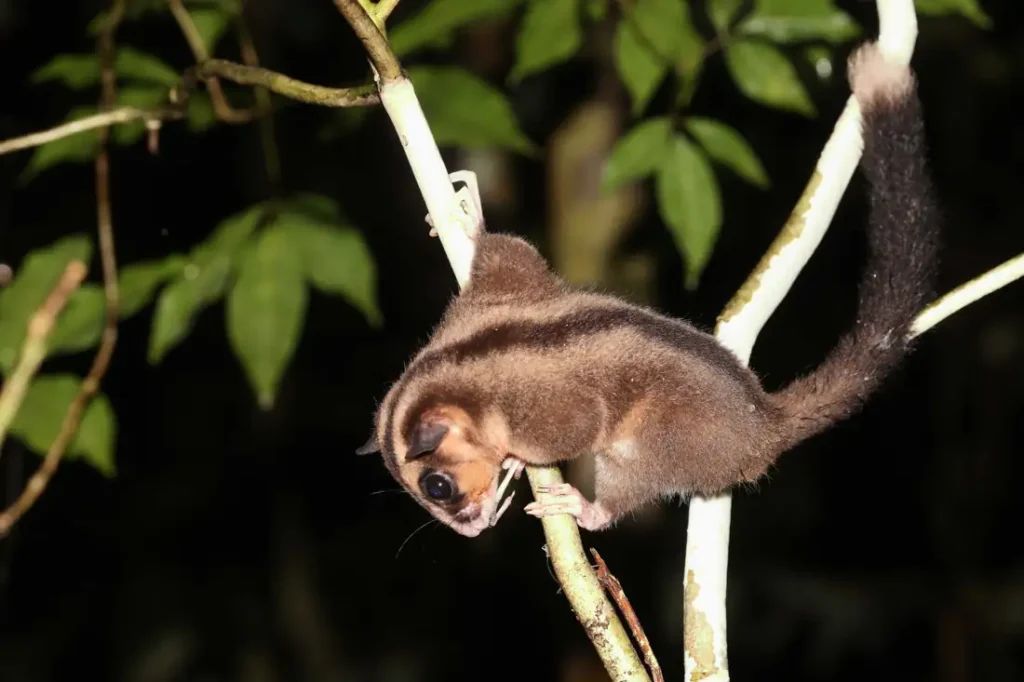
In June 2023, on our very first expedition to West Papua, the people of Klalik brought us a small striped possum with an extraordinarily long finger. It turned out to be the Pygmy Long-fingered Possum (Dactylonax kambuayai), a species described from fossils and believed to have been extinct for around 6,000 years. Carlos’s photographs were the first ever taken of a living animal. The rediscovery was announced in March 2026, in a paper led by Tim Flannery and co-authored by Carlos Bocos (Flannery et al. 2026, Records of the Australian Museum), and made news around the world.
The press release did not say so, but the animal was found on a mammal watching trip. As Jon Hall wrote on mammalwatching.com the day after the announcement, it is a perfect example of what people who travel to see mammals can contribute to science. Read the full story of the rediscovery.
Why mammal watchers find what surveys miss
Mammals are far less known than birds. When Vladimir Dinets and Jon Hall reviewed the subject in 2018, the IUCN listed 799 mammal species, 14.7% of all mammals, as Data Deficient, against just 62 bird species, or 0.6%. Many of the gaps are small, nocturnal and arboreal species, exactly the animals that standard methods struggle with:
- Camera traps on the ground miss the canopy. In a Bornean rainforest, cameras set in the canopy recorded 18 mammal species that ground cameras never detected (Haysom et al. 2021). In Rwanda, adding arboreal cameras to ground cameras and transects improved detection of many species (Moore et al. 2020).
- Thermal imaging outshines the spotlight. In the rainforests of northern Queensland, observers with a hand-held thermal imager detected almost twice as many nocturnal arboreal mammals as with a spotlight; spotlighting underestimated the number of each species by 33 to 100% (Underwood et al. 2022).
- Small species benefit most. For the tiny Eastern Pygmy Possum, thermal cameras gave detection probabilities three to five times higher than spotlighting, especially in dense vegetation (Madani & Gonsalves, Wildlife Research).
Mammal watchers combine exactly these strengths: hour after hour of slow night walks with thermal scopes, cameras ready, local guides and community knowledge, and a willingness to go to places that few scientists can visit regularly. The result is a steady stream of records that matter.
A growing track record
Dinets & Hall (2018) collected examples of what the mammal watching community had already achieved: the rediscovery of the Javan Small-toothed Palm Civet, the first documented record of Pousargues’s Mongoose in Uganda since the 1970s, the first documented Altai Weasels in Ladakh, the first Arunachal Macaque documented in Kaziranga National Park, and distribution data that helped map the Olinguito. Since then, trip reports and photographs shared on mammalwatching.com have kept adding new localities, range extensions and behavioural observations.
From our own field notebooks
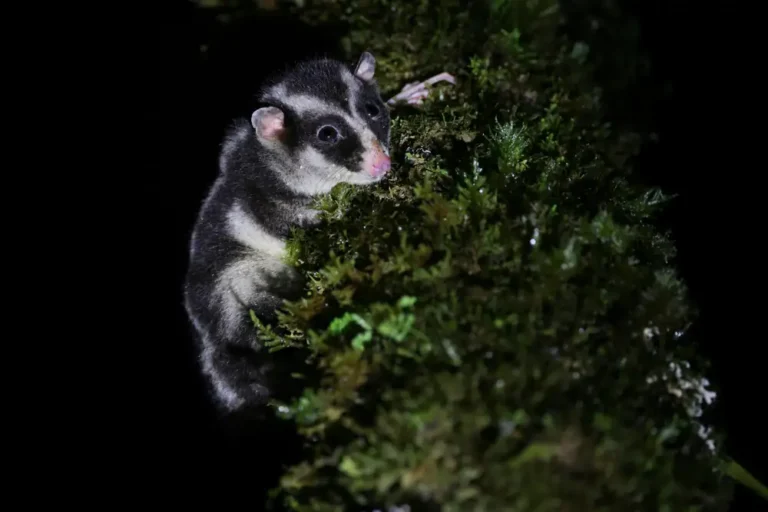
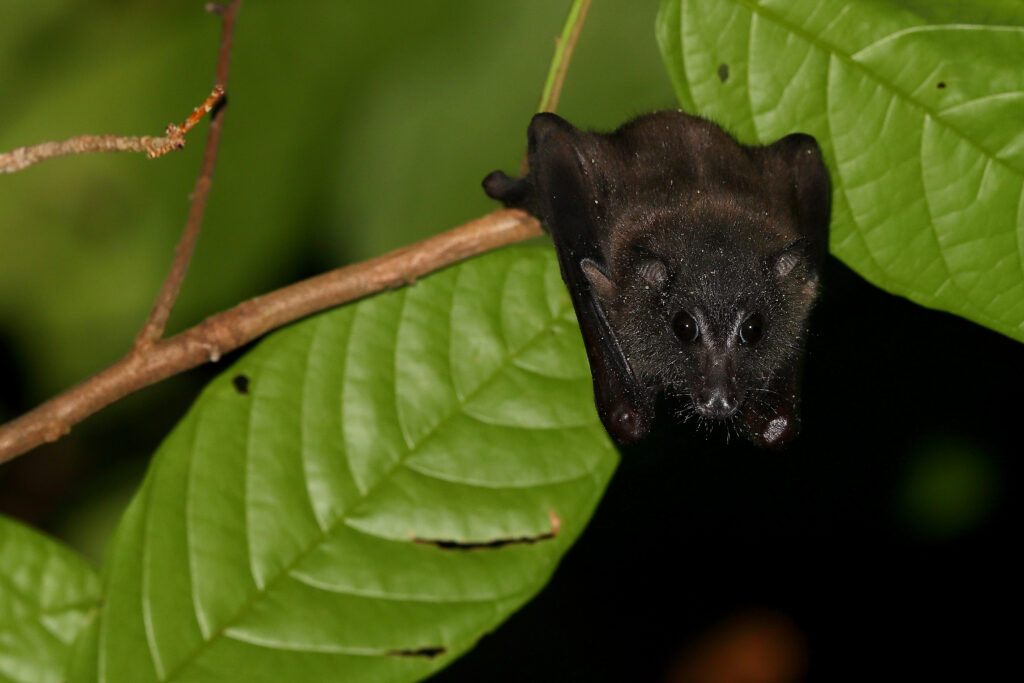
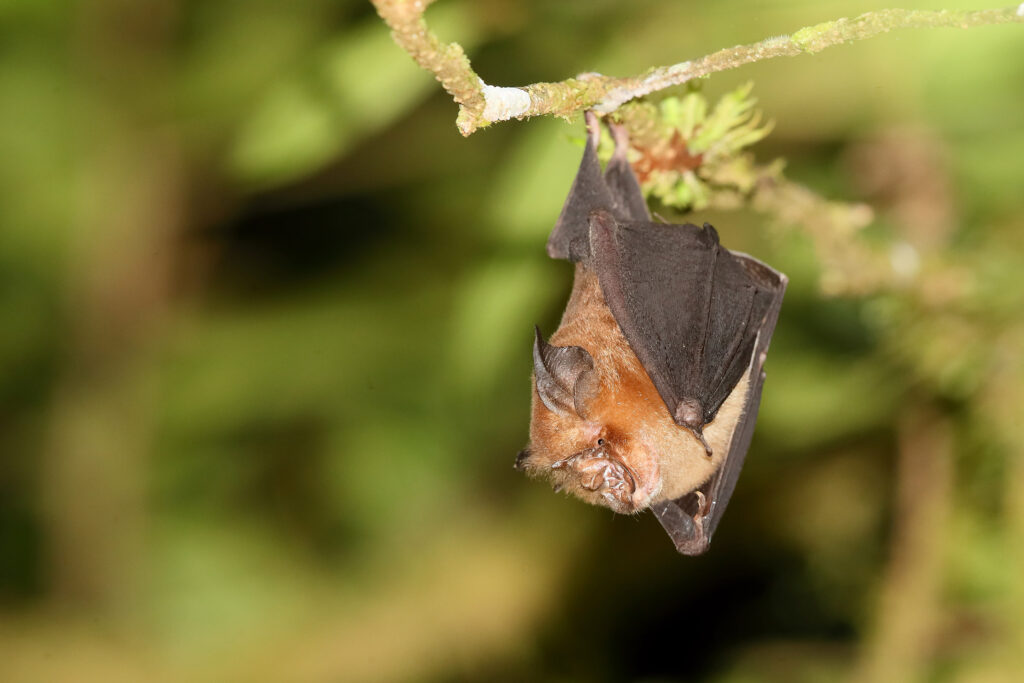
- Pygmy Long-fingered Possum: the first living animals ever documented (West Papua, 2023).
- Long-fingered trioks: Carlos co-authored the 2026 revision that split them into a western and an eastern species, and his 2025 photograph of the Eastern Long-fingered Triok (Dactylonax ernstmayri) is one of very few of a living animal; iNaturalist holds just three records of the species worldwide.
- New Guinea Jumping Mouse (Lorentzimys): recorded at Malagufuk, a poorly known genus not previously found anywhere near the Vogelkop.
- Manado Fruit Bat (Boneia bidens): among the very few photographs of living animals of this Sulawesi endemic.
- An undescribed horseshoe bat (Rhinolophus sp.), found by Carlos and the Belgian bat ecologist Nils Bouillard in 2019, during Nils’s Big Bat Year, the first attempt to see as many of the world’s bats as possible in a single year. Nils tells the story in his book Big Bat Year, and the species is still awaiting formal description.
Surveys and collaboration
We share our records and photographs with researchers, and we offer mammal survey consultancy: we can join or lead surveys anywhere in the world to find and document an area’s mammals, including environmental impact assessments in Indonesia and New Guinea, with particular expertise in nocturnal mammals, bats and rodents. If you are a researcher, a conservation organisation or a company that needs to know which mammals live on a site, get in touch.
And if you simply love mammals, joining one of our expeditions is a way to see extraordinary animals and, perhaps, to be there the night something new turns up.
References
- Bouillard, N. (2023). Big Bat Year: A Conservation Story. Pelagic Publishing.
- Dinets, V. & Hall, J. (2018). Mammalwatching: a new source of support for science and conservation. International Journal of Biodiversity and Conservation 10(4): 154–160. Open access
- Flannery, T. et al. (2026). Records of the Australian Museum. Paper
- Hall, J. (2026). New Pygmy Triok discovered after 6000 years (by us!). mammalwatching.com
- Haysom, J. K. et al. (2021). Life in the canopy: using camera-traps to inventory arboreal rainforest mammals in Borneo. Frontiers in Forests and Global Change 4: 673071. Link
- Madani, G. & Gonsalves, L. Size does matter: detectability of arboreal mammals using thermal cameras and spotlighting. Wildlife Research. Link
- Moore, J. F. et al. (2020). Comparison of species richness and detection between line transects, ground camera traps, and arboreal camera traps. Animal Conservation 23(5): 561–572. Link
- Underwood, A. H., Derhè, M. A. & Jacups, S. (2022). Thermal imaging outshines spotlighting for detecting cryptic, nocturnal mammals in tropical rainforests. Wildlife Research 49(6): 491–499. Link
