
Tarsiers are tiny nocturnal primates with the largest eyes, relative to body size, of any mammal – and Sulawesi is the tarsier capital of the world. The genus Tarsius lives only on Sulawesi and its surrounding islands, and it is still evolving in front of our eyes: almost every peninsula, mountain range and offshore island has its own tarsier, and new ones are still waiting to be described.
At Mammalia, tarsiers are not a side-show. We were the first company to run tours dedicated to finding all the tarsiers of Sulawesi, and we have been doing it for years. We have seen every described species on the island, plus several forms that science has not yet named.
Yoda, Gizmo and E.T.: tarsiers in popular culture
Even people who have never heard the word “tarsier” have probably seen one – or at least something that looks a lot like one. With their huge eyes, big ears and long, slender fingers, tarsiers look like movie creatures, and several famous movie creatures do look like tarsiers.
- Gizmo (Gremlins, 1984). This is the best-documented case. Chris Walas, who designed and built the Mogwai, has said that his first idea after reading the script was to take a tarsier and give it cartoon proportions, with big eyes to make it cute (Empire). Years later he shared his very first Mogwai sketches and pointed out the tarsier influence (Bloody Disgusting).
- Yoda (Star Wars). For decades fans and primatologists have said that Yoda looks like a tarsier (WIRED). Lucasfilm has never confirmed it, and Yoda’s makeup designer Stuart Freeborn said he based the face partly on his own. The link stuck anyway: primatologists chose 4 May, Star Wars Day, as International Tarsier Day, and two Sulawesi species – Gursky’s Spectral Tarsier and Jatna’s Tarsier, both of which we see on our tours – were described on 4 May 2017 (Mongabay, National Geographic).
- E.T. (E.T. the Extra-Terrestrial, 1982). E.T. is often compared to a tarsier, especially in the Philippines and Indonesia (Edge Davao). The resemblance is real, but there is no evidence that it was intentional: Steven Spielberg has said that E.T.’s eyes were modelled on photographs of Albert Einstein, Ernest Hemingway and Carl Sandburg (TIME).
- Echo (Earth to Echo, 2014). Director Dave Green kept a picture of a baby tarsier on his wall while the little alien Echo was being designed, and it helped shape its giant eyes (Gizmodo).
The real animals are even stranger than the movie versions. Each of a tarsier’s eyes is about as big as its whole brain (Scientific American). The eyes cannot move in their sockets, so tarsiers turn their heads almost 180 degrees in each direction instead. They are the only primates that eat nothing but live animals, and some species call to each other in ultrasound, far above what human ears can hear.
One island, more tarsiers than macaques
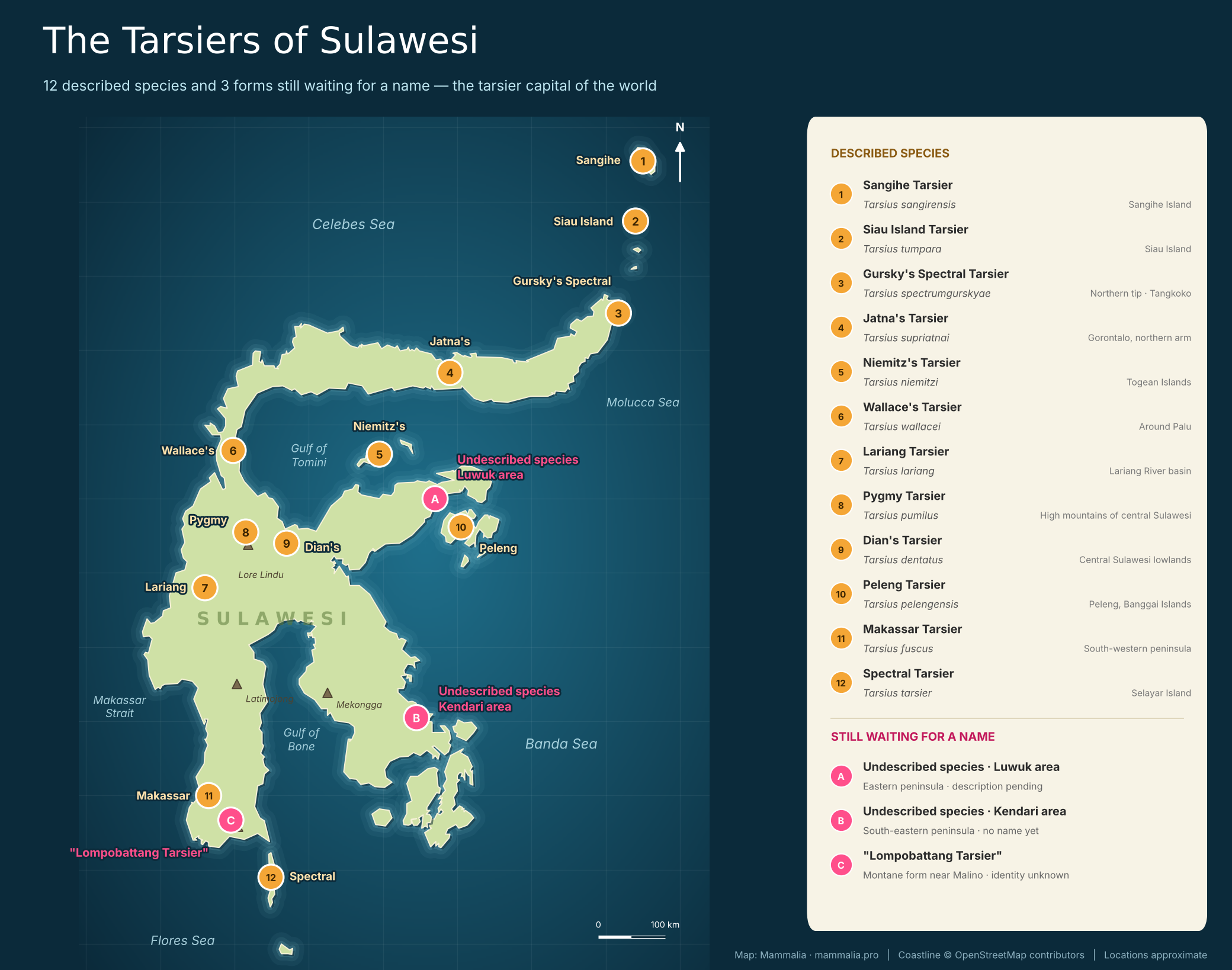
Sulawesi is famous for its seven species of endemic macaques, each one occupying its own part of the island. The tarsiers have gone further. Twelve species of Tarsius have been described so far, all of them on Sulawesi and its satellite islands – more tarsier species than macaque species – and several more are known to exist but have not yet been formally named.
The reason lies in Sulawesi’s turbulent geology. The island was assembled from several separate pieces of land that only joined together relatively recently, and each of those ancient islands seems to have had its own tarsier before they merged. Sea-level changes isolated further populations on Peleng, the Togean Islands, Sangihe, Siau and Selayar. The result is an extraordinary mosaic of species that often look very similar, but sing completely different songs.
How do you tell tarsiers apart?
Many Sulawesi tarsiers are told apart by their voices before anything else. Unlike their Philippine and Bornean relatives, which are mostly solitary, Sulawesi tarsiers live in small family groups that sing duets at dawn as they return to their sleeping trees – a fig, a bamboo clump or a tangle of vines. Each species has its own duet, and recordings of these calls have been one of the keys to discovering new species. Add DNA, fur colour, tail tuft, size and, above all, geography, and the picture becomes clear: every region of Sulawesi has its own tarsier.
The described tarsiers of Sulawesi
| Species | Where it lives |
|---|---|
| Spectral Tarsier (Tarsius tarsier) | Selayar Island, off the southwestern peninsula |
| Makassar Tarsier (Tarsius fuscus) | Southwestern peninsula, around Makassar |
| Dian’s Tarsier (Tarsius dentatus) | Central Sulawesi lowlands and hills |
| Pygmy or Mountain Tarsier (Tarsius pumilus) | High mountains of Central Sulawesi |
| Lariang Tarsier (Tarsius lariang) | Lariang River basin, western Central Sulawesi |
| Wallace’s Tarsier (Tarsius wallacei) | Around Palu, Central Sulawesi |
| Gursky’s Spectral Tarsier (Tarsius spectrumgurskyae) | Northeastern tip of the northern peninsula (Tangkoko) |
| Jatna’s Tarsier (Tarsius supriatnai) | Northern peninsula, Gorontalo region |
| Niemitz’s Tarsier (Tarsius niemitzi) | Togean Islands |
| Peleng Tarsier (Tarsius pelengensis) | Peleng Island, Banggai Archipelago |
| Sangihe Tarsier (Tarsius sangirensis) | Sangihe Island, north of Sulawesi |
| Siau Island Tarsier (Tarsius tumpara) | Siau Island, north of Sulawesi |
Tarsiers waiting for a name
Twelve species is only the official count. On our tours we also look for tarsiers that are known to exist but have not yet been formally described – and we have seen them all:
- The Luwuk tarsier. The tarsier of the Luwuk area, on the eastern peninsula, is a distinct form that is still pending a formal description.
- The Kendari tarsier. The tarsier of the south-eastern peninsula, around Kendari, has no scientific name yet, and no description is underway. On paper it is still filed under the Spectral Tarsier (Tarsius tarsier): the IUCN range map for that species covers the south-eastern peninsula, because the last assessment simply lumped in every Sulawesi tarsier that had not yet been assigned to another species (Handbook of the Mammals of the World). It is a provisional patch rather than a real answer. The original Spectral Tarsier – the species on which the whole genus Tarsius was founded – lives only on Selayar Island, off the tip of the opposite, south-western peninsula, since Groves and Shekelle restricted its type locality there in 2010. The Kendari tarsier is, in other words, a species waiting for its own name.
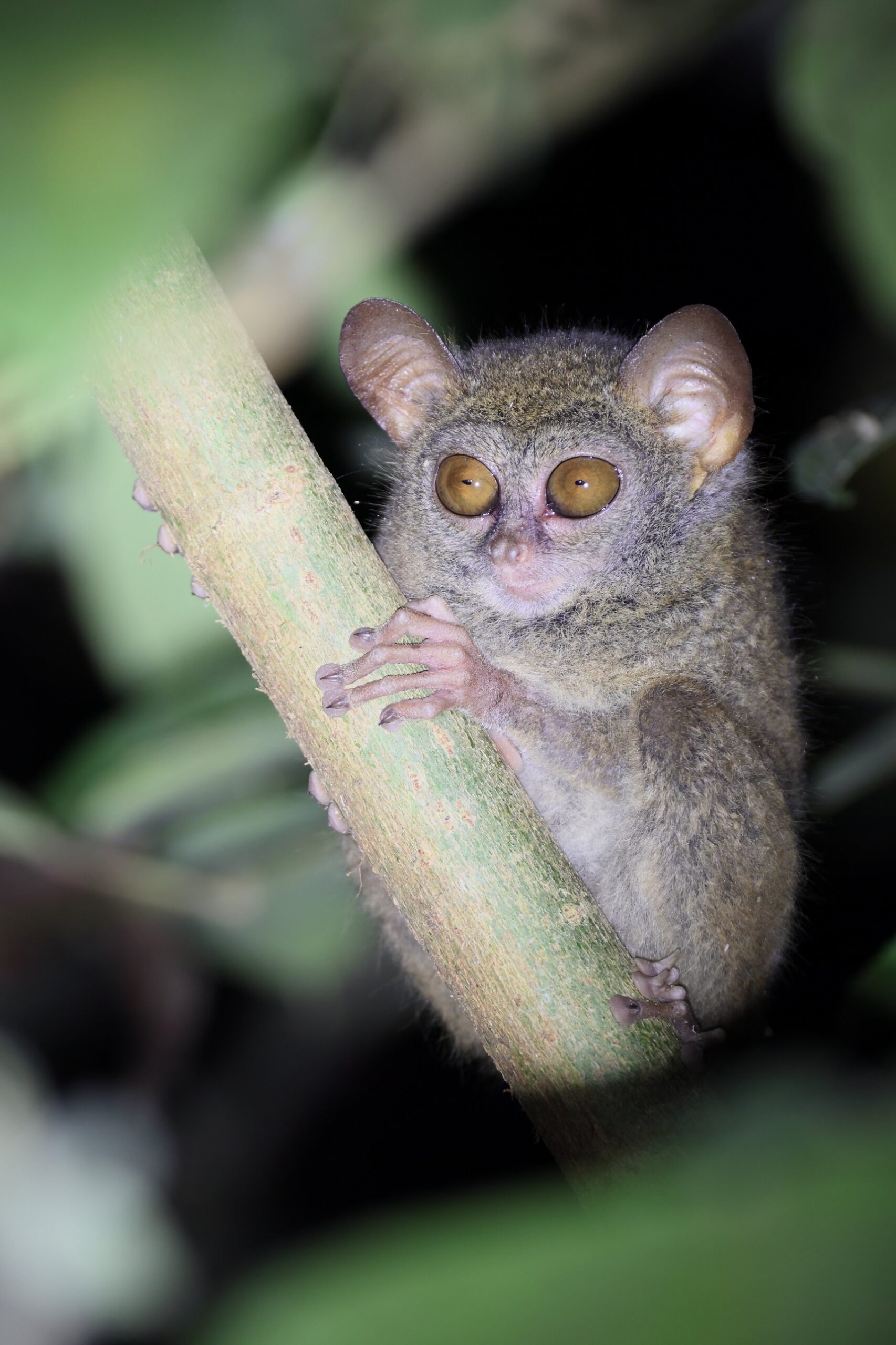
- The Lompobattang tarsier. High on Gunung Lompobattang, near Malino in South Sulawesi, lives a small montane tarsier whose identity is still a mystery. We found and photographed it in 2025 and nicknamed it the “Lompobattang Tarsier” (mammalwatching.com). Is it a highland form of the Makassar Tarsier, or something much older? There are good reasons to suspect the second. Genetic work has shown that the Pygmy Tarsier is not a dwarfed lowland tarsier but the most ancient lineage of all Sulawesi tarsiers, which split from the rest almost ten million years ago and now survives only in cloud forest above about 1,800 m (Hagemann et al., 2022, Biology Letters). Mountain tarsiers were once found well beyond Central Sulawesi: one of the very few museum specimens was collected in 1930 in the mountains of South Sulawesi. If an old, mountain-adapted lineage once lived along the high ranges of the island, the mossy summit forests of Lompobattang are exactly where a Pygmy-like tarsier could still be hiding.
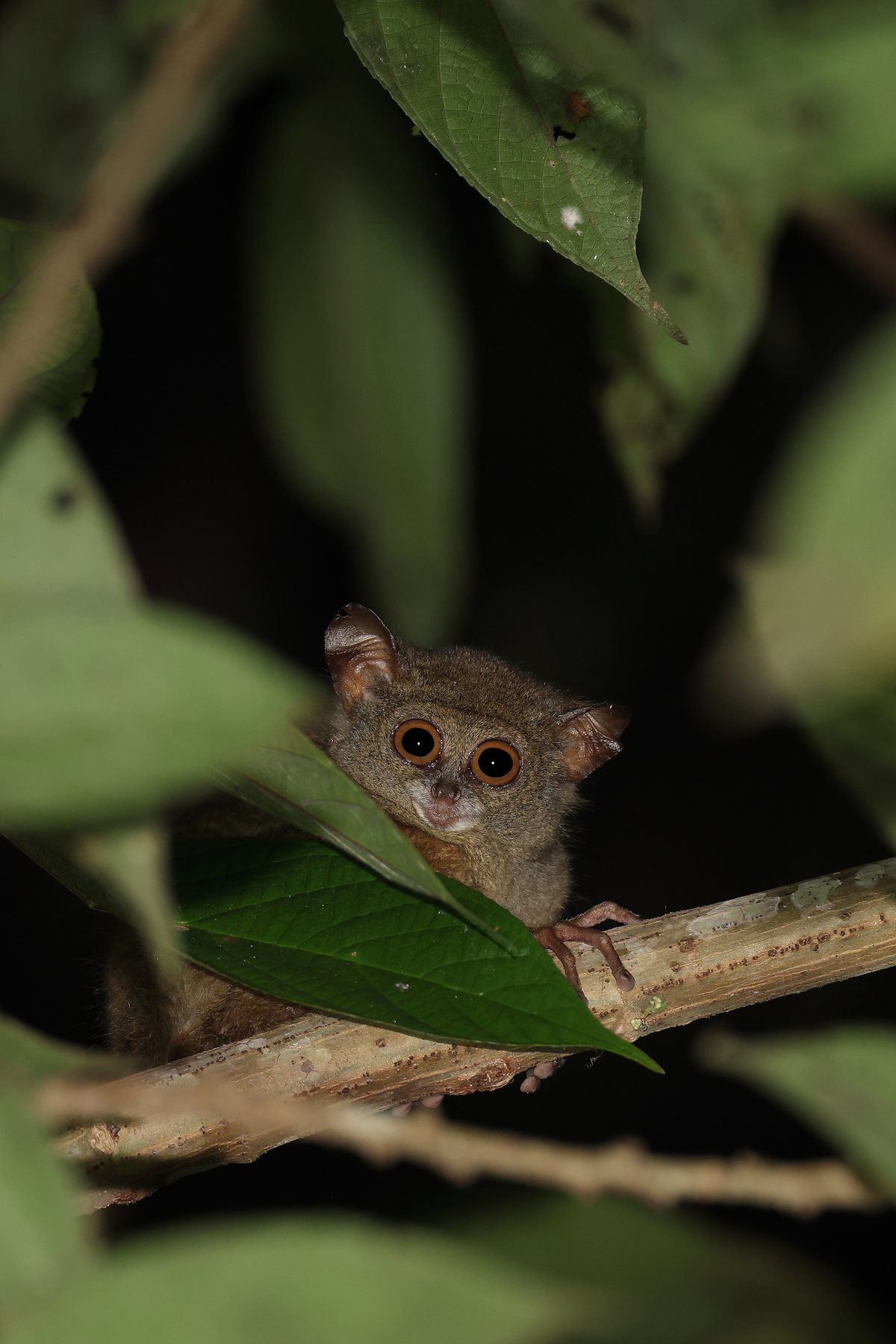
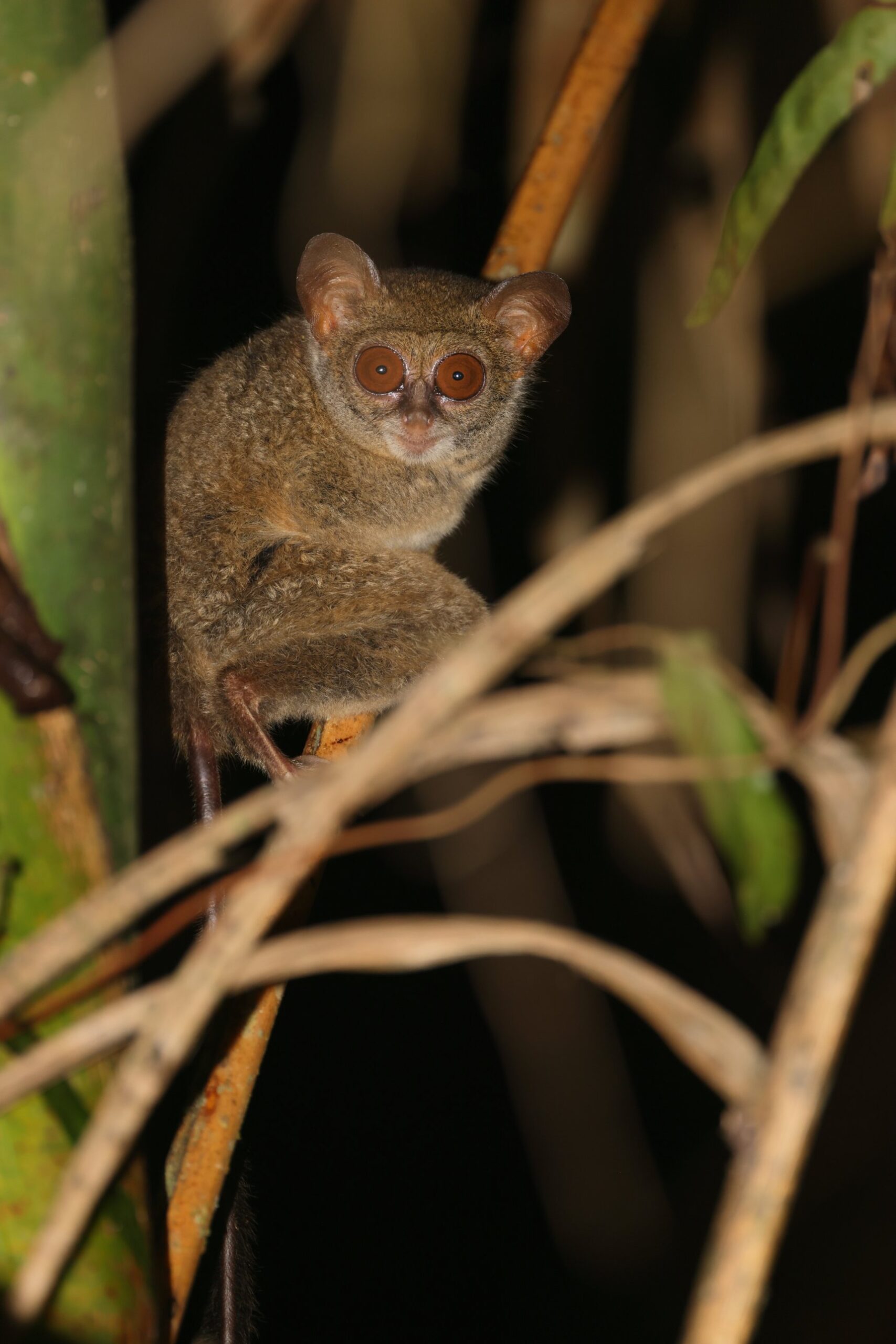
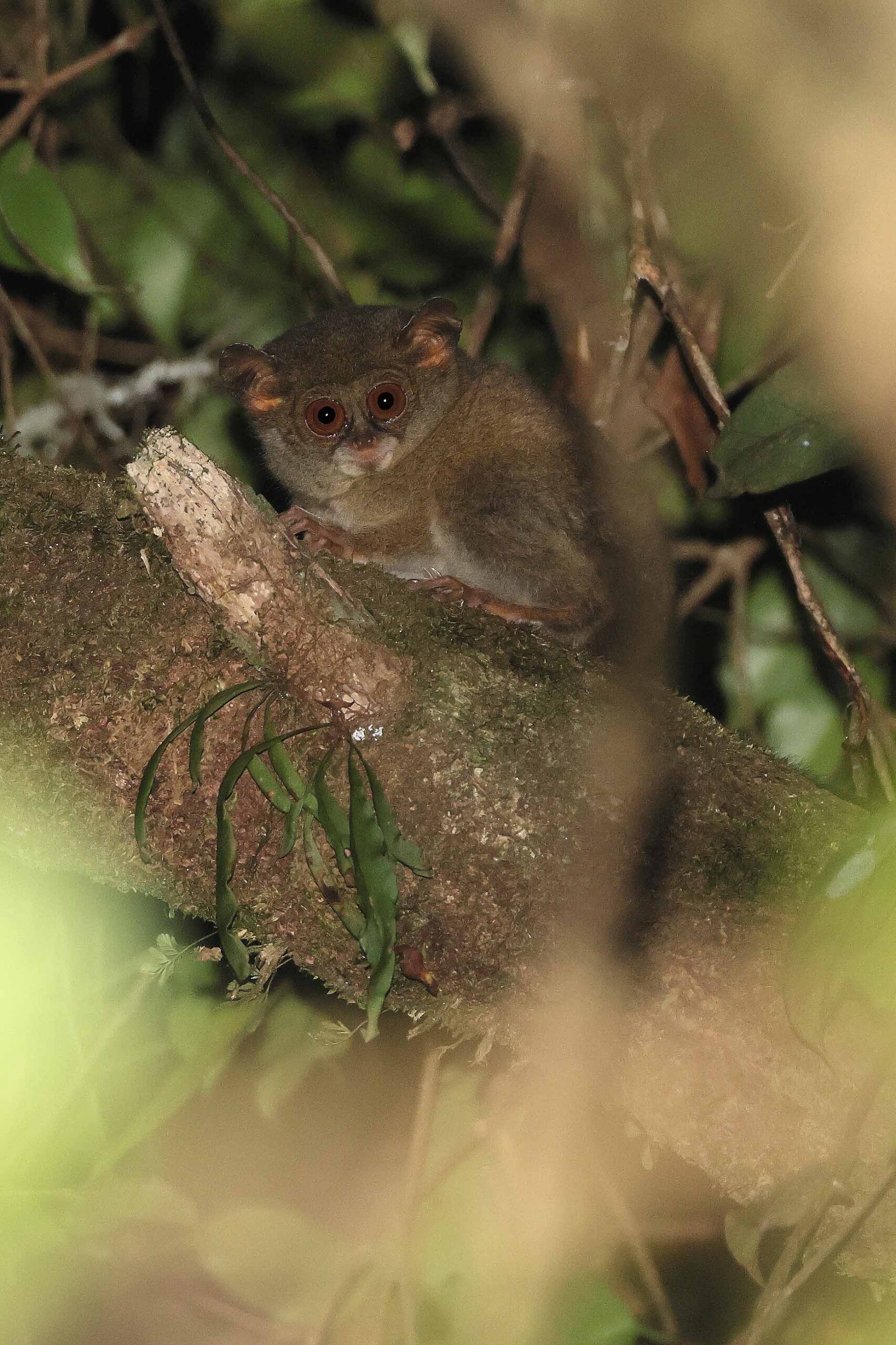
Photos: Carlos Bocos.
Seeing these animals is a chance to watch taxonomy happen in real time – and every record and photograph we obtain helps the scientists who are working to name them.
The holy grail: the Pygmy Tarsier
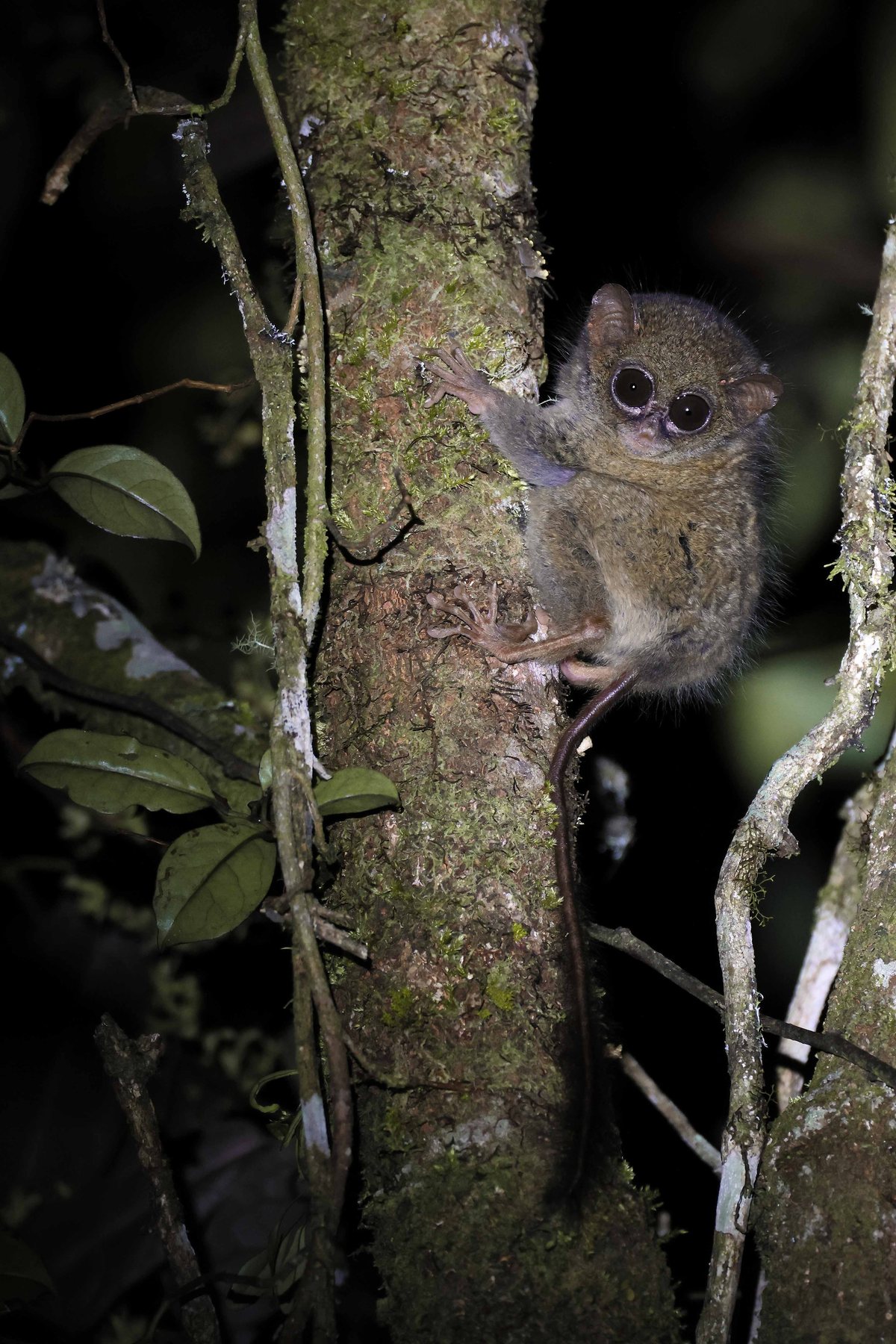
The Pygmy Tarsier (Tarsius pumilus) is the most enigmatic tarsier of all. It is the smallest, it has claws instead of nails on its fingers – something almost unique among primates – and it lives in cold, mossy cloud forest high in the mountains of Central Sulawesi. It was described in 1921 from museum specimens and, after that, nobody saw it alive for more than eighty years. Some primatologists believed it was extinct, until a single animal was accidentally caught in a rat trap in 2000 and a research team found a few more in 2008.
Since then it has remained practically invisible. Mammalia is, to our knowledge, the only team to have found the Pygmy Tarsier in recent years, in the high mountains of Central Sulawesi. It takes long, cold nights at altitude, patience and a great deal of local knowledge – and it is the ultimate prize for any tarsier enthusiast.
The voice of the Pygmy Tarsier
Lowland tarsiers announce themselves every dawn with loud family duets. The Pygmy Tarsier does the opposite. The only published field study of its calls found that, compared with its lowland relatives, it communicates in a far more cryptic way: it does not scent-mark and it lacks the lower-pitched calls of the larger species, relying instead on very high-pitched calls, and its vocalisations have been described as ultrasonic (Grow, 2019, Folia Primatologica). Other tarsiers are known to use pure ultrasound: the Philippine Tarsier calls at around 70 kHz, far above the roughly 20 kHz limit of human hearing (Ramsier et al., 2012, Biology Letters).
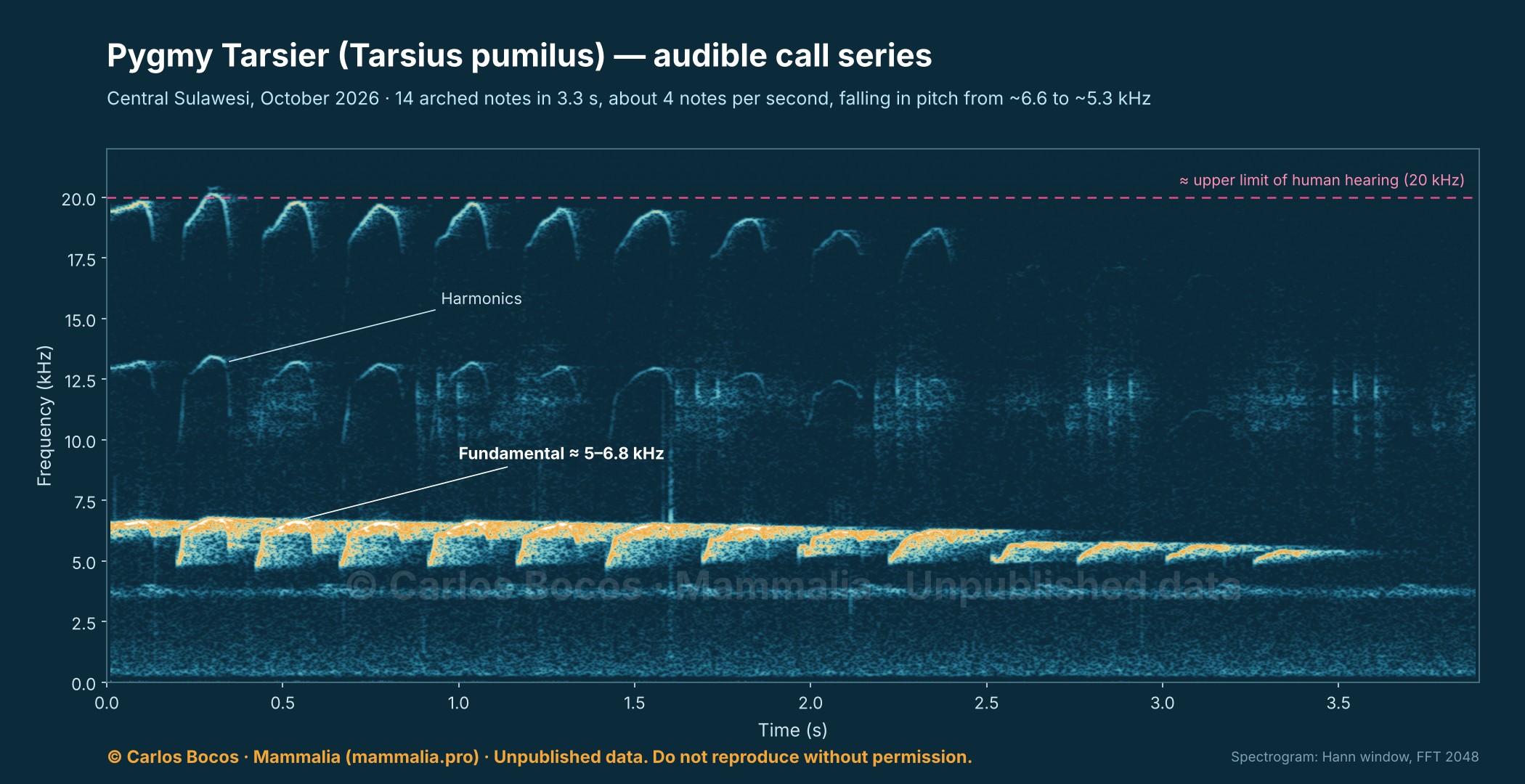
That is why our expedition in October 2026 was so exciting. In the mountains of Central Sulawesi we finally managed to record Pygmy Tarsier vocalisations that are perfectly audible to the human ear. To the best of our knowledge, this is the first time that audible calls of the Pygmy Tarsier have ever been documented – a small but real addition to what we know about one of the least-known primates on Earth.
The recording below shows one of these calls: a series of 14 short, arched notes delivered at about four notes per second over just over three seconds. Each note rises and then falls, with its main energy between roughly 5 and 6.8 kHz – well within the range of human hearing – and the whole series gradually drops in pitch, from about 6.6 to 5.3 kHz. Fainter harmonics appear at around 13 and 19–20 kHz.
A paradise for primate lovers: nearly 20 primates on one island
Add the macaques to the tarsiers and Sulawesi becomes one of the most exciting primate destinations on Earth. Twelve described tarsiers, seven endemic macaques and at least three tarsier forms still without a name add up to around twenty different primates – none of which lives anywhere else in the world. Like the tarsiers, each macaque has its own part of the island, from the jet-black, punk-crested Celebes Crested Macaque of the far north-east to the Booted Macaque of the south-east.
| Macaque | Where it lives |
|---|---|
| Celebes Crested Macaque (Macaca nigra) | North-eastern tip (Tangkoko) – Critically Endangered |
| Gorontalo Macaque (Macaca nigrescens) | Central part of the northern arm |
| Heck’s Macaque (Macaca hecki) | Western part of the northern arm |
| Tonkean Macaque (Macaca tonkeana) | Central Sulawesi and the Togean Islands |
| Moor Macaque (Macaca maura) | South-western peninsula |
| Booted Macaque (Macaca ochreata) | South-eastern peninsula |
| Buton Macaque (Macaca brunnescens) | Buton and Muna islands |
Very few places allow you to see so many endemic primates in a single trip, and almost nobody tries to see them all. A Sulawesi tour designed around primates – tarsiers by night, macaques by day – is a unique experience for anyone who loves these animals, and it is exactly what we do best.
Why your visit matters: ecotourism and primate conservation
Most of Sulawesi’s primates live in forests that are shrinking fast, and several of them are threatened. Well-run wildlife tourism is one of the few tools that turns a living tarsier or macaque into a reason to keep the forest standing. Every group that comes to look for tarsiers pays local guides, drivers, cooks and homestays, and shows communities and authorities that intact forest – and the animals in it – are worth more than cleared land.
Tourism also produces knowledge. Many of the tarsiers on this page were first noticed, or first photographed and recorded, by naturalists in the field, and the records, photographs and sound recordings we collect on our trips are shared with the researchers who are working to describe and protect these species.
But ecotourism only helps if it is done well. A classic study at Tangkoko, the most visited tarsier site in Sulawesi, found that as tourism grew quickly, the money was not reaching local people and the behaviour of the primates was being affected (Kinnaird & O’Brien, 1996, Oryx). That is why we travel in small groups, work with local guides, never handle, feed or bait the animals, and keep the time we spend at each sleeping tree, and the noise we make, to a minimum. For photography we use short flash bursts rather than keeping a torch on the animals for long periods, which we believe disturbs them far less. Watching a tarsier family wake up at dusk should never come at the animals’ expense.
See the tarsiers of Sulawesi with us
Our Sulawesi mammals tour is built around tarsiers. We visit the regions where the different species live, listen for their dawn duets, and search for them at night with thermal imaging, so that you see the animals well without disturbing them. Along the way we look for many other Sulawesi endemics: babirusa, anoa, bear cuscuses, endemic macaques and fruit bats.
If you want to see as many tarsiers as possible – including the ones that do not yet have a name – there is no better way to do it.
Tarsier FAQ
How many species of tarsier are there in Sulawesi?
Twelve species of Tarsius have been described so far, all on Sulawesi and its surrounding islands, and several more are known but not yet named. Worldwide, there are two more tarsier species: the Philippine Tarsier (Carlito syrichta) and Horsfield’s Tarsier (Cephalopachus bancanus) in Borneo and Sumatra.
Where is the best place to see tarsiers?
Sulawesi, without a doubt. No other place in the world has so many species, and with the right guide several of them can be seen on a single trip.
Are tarsiers endangered?
Many are. Several species live on a single island or a small area and are threatened by habitat loss. The Siau Island Tarsier, for example, is listed as Critically Endangered.
Are tarsiers nocturnal?
Yes. They spend the day sleeping in dense vegetation and come out at dusk to hunt insects. The best moments to see them are at dusk, when they leave their sleeping trees, and at night.
What is the smallest tarsier?
The Pygmy Tarsier (Tarsius pumilus) of the Central Sulawesi mountains, which weighs around 50 grams.
Can you hear tarsiers?
Yes – most Sulawesi tarsiers sing loud duets at dawn and dusk that are easy to hear, and this is often how we find them. But tarsiers also use ultrasound that humans cannot hear, and the Pygmy Tarsier in particular communicates in a very discreet way. In October 2026 we recorded audible calls of the Pygmy Tarsier – to the best of our knowledge, the first time this has been documented.
Is tarsier watching good for conservation?
It can be, if it is done responsibly. Small groups, local guides, no handling or feeding and minimal disturbance at sleeping trees mean that visitors bring income to local communities and a reason to protect the forest, without harming the animals.
