
They look like a cross between a kangaroo, a bear and a lemur, they live in some of the most remote mountains on Earth, and most people have never heard of them. Tree kangaroos are among the strangest – and most wonderful – mammals on the planet. Here are ten things about them that surprise almost everyone.
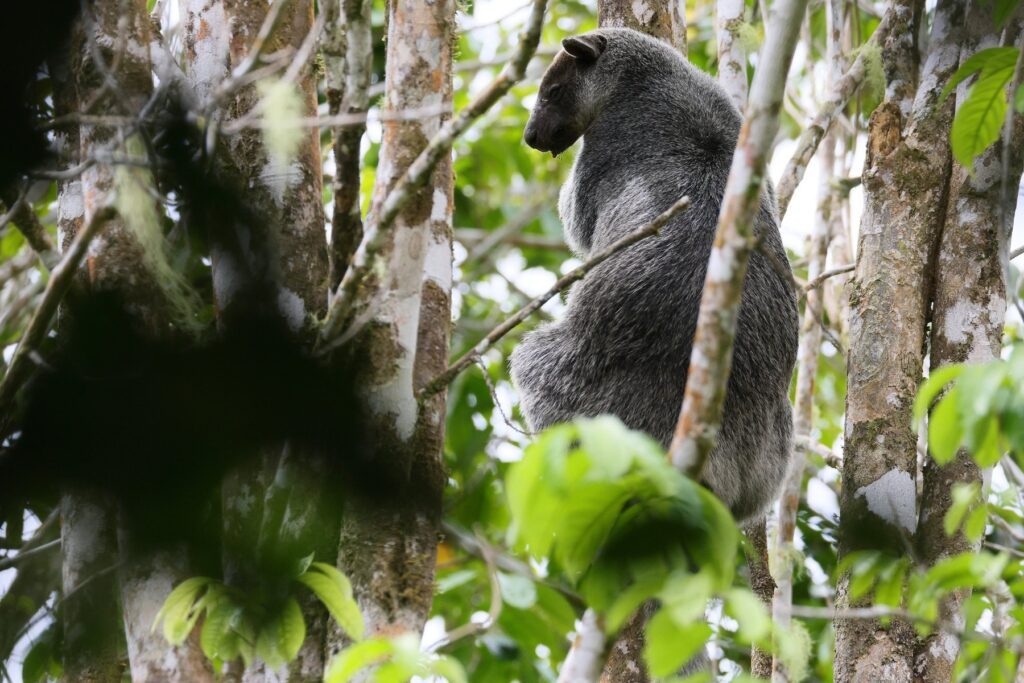
1. They are kangaroos that went back to the trees
Tree kangaroos descend from kangaroos that lived on the ground and hopped, like their relatives today. At some point, for reasons that are still a mystery, some of them climbed back up into the trees. DNA suggests that their closest living relatives are the rock-wallabies, and that the group began to evolve around seven million years ago. That is why they still look like kangaroos, but with shorter, broader feet, strong curved claws and powerful forearms built for climbing.
2. They can walk – and even move backwards
Ground kangaroos can only move both hind legs together. Tree kangaroos can move them independently, so they can walk along a branch one foot after the other. They are also the only kangaroos that can move backwards, which is very useful when you are edging along a thin branch high in the canopy.
3. Their tail is a balancing pole, not a fifth hand
A tree kangaroo’s tail is long, heavy and often as long as its body, but it is not prehensile: it cannot grip branches like a monkey’s. Instead it works as a counterweight, helping the animal balance as it climbs and leaps. In the field, a long tail hanging down from a clump of leaves is often the first clue that a tree kangaroo is up there.
4. They come down the tree tail first – and then jump
Tree kangaroos climb up a trunk by wrapping their forearms around it and pushing with their hind legs. Coming down, they slide backwards, tail first, and then simply let go and jump to the ground, sometimes from as high as ten metres, landing unhurt.
5. There are only around fourteen species – and most live in New Guinea
Depending on the taxonomy used, there are around fourteen species. Two live in the rainforests of Queensland, Australia – Lumholtz’s and Bennett’s Tree Kangaroos – and all the others live on the island of New Guinea. Many are found only in a single mountain range, and some are known from just a handful of valleys.
6. One of them hardly climbs at all
The Dingiso (Dendrolagus mbaiso), a striking black-and-white species of the high mountains of West Papua, was only described by science in 1995. Unlike its relatives, it spends most of its time on the ground, at up to 4,000 metres. Its scientific name means “the forbidden animal” in the Moni language: for the Moni people it is sacred, and it is not hunted – one of the reasons it is unusually calm with people.
7. One was lost to science for 90 years
The Wondiwoi Tree Kangaroo (Dendrolagus mayri) was known from a single specimen collected in 1928 in the Wondiwoi Mountains of West Papua. Nobody saw it again for ninety years, and many thought it was extinct – until 2018, when British botanist Michael Smith, who was there to look for rhododendrons, photographed one high in the forest. It remains one of the rarest mammals in the world.
8. They are leaf-eaters that spend hours resting
Tree kangaroos feed mainly on leaves and fruit, plus flowers, buds, sap and bark. A diet of leaves gives little energy, so they spend long hours resting, sitting hunched in the canopy where they can look just like a mossy clump or a termite nest. Seeing one often comes down to patience and sharp eyes.
9. Mothers raise one joey at a time – for a long time
Like all kangaroos, tree kangaroos give birth to a tiny, undeveloped young that crawls into the pouch. Each female raises a single joey, which stays in or near the pouch for many months and is not fully weaned until it is around a year old. Such slow breeding is one of the reasons why hunting hits tree kangaroo populations so hard.
10. Communities and ecotourism can save them
Most tree kangaroos are threatened by hunting and forest loss, and several are Endangered or Critically Endangered. But there is good news. In the Torricelli Mountains of Papua New Guinea, hunting moratoriums agreed by local communities helped the Critically Endangered Tenkile recover from perhaps 100 animals in the 1990s to around 300 today. We believe carefully managed ecotourism can do the same elsewhere: when a living tree kangaroo is worth more to the people who own the forest than a dead one, everybody wins.
Want to see one?
Mammalia is the only mammal watching company specialised in tree kangaroos in New Guinea. On our West Papua tour we search for two species in the mountains of the Vogelkop Peninsula – the Vogelkop and Grizzled Tree Kangaroos – and on our Papua New Guinea tour we look for Doria’s Tree Kangaroo in the Owen Stanley Range. To find out where every species lives and which ones can be seen, read our complete guide to tree kangaroos, or write to us at info@mammalia.pro.