
Tree kangaroos (genus Dendrolagus) are among the rarest, most localised and most sought-after mammals on Earth. They are kangaroos that went back to living in the trees, with strong forearms, long balancing tails and thick fur. Most species live only in the mountain forests of New Guinea, many are known from just a few valleys, and a few have hardly ever been seen alive. For mammal watchers, seeing a tree kangaroo in the wild is one of the great prizes. Mammalia is the only mammal watching company specialised in tree kangaroo watching in New Guinea, and they are at the heart of our tours to West Papua and Papua New Guinea.
Rare, elusive and localised
There are around fourteen species. Two live in the rainforests of Queensland, Australia, and the rest are found on the island of New Guinea. They spend most of their lives high in the canopy, many are active mainly at night, and they have been hunted for centuries, so where they survive they are usually shy and hard to find. Several species live in a single mountain range, and some are protected by local communities, by sacred beliefs or by strict hunting bans. For many of them, simply getting there is a challenge: remote mountains, land-rights issues or political instability.
Mammal watcher Daniel Boyland, who spent two seasons searching for tree kangaroos across New Guinea, wrote an excellent account of where each species can be searched for. You can read his New Guinea 2025 & 26 report on mammalwatching.com. What follows draws on his experience, on the work of conservation groups such as the Tenkile Conservation Alliance and the Tree Kangaroo Conservation Program, and on our own years in the field.
The species you can see with us
Vogelkop (Ursine) Tree Kangaroo and Grizzled Tree Kangaroo – West Papua
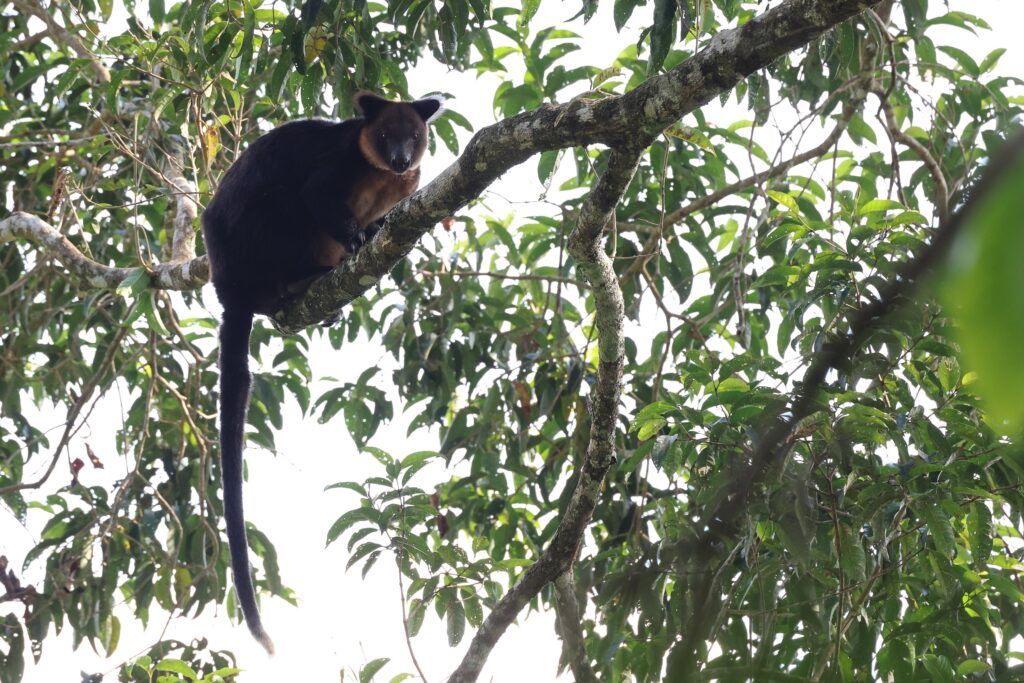
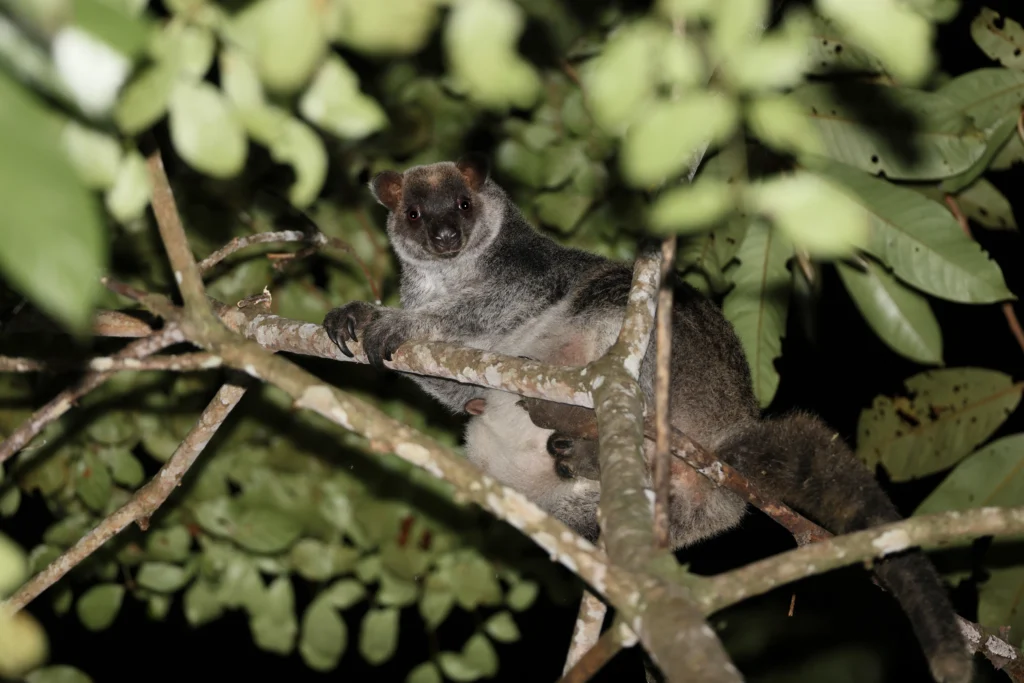
The mountains of the Vogelkop (Bird’s Head) Peninsula are the best place in the world to see two species of tree kangaroo on one trip. The Vogelkop or Ursine Tree Kangaroo (Dendrolagus ursinus), a dark, bear-like species, lives only on the Vogelkop and possibly the Fakfak Peninsula. The Grizzled Tree Kangaroo (Dendrolagus inustus) is a grey, long-tailed species of northern and western New Guinea. Both are listed as Vulnerable. Where hunting pressure is low, the Ursine Tree Kangaroo can be surprisingly confiding. Both are the main specialty of our West Papua tree kangaroo and mammal watching tour, which also visits Klalik, home of the Western Long-beaked Echidna.
Doria’s Tree Kangaroo – Papua New Guinea
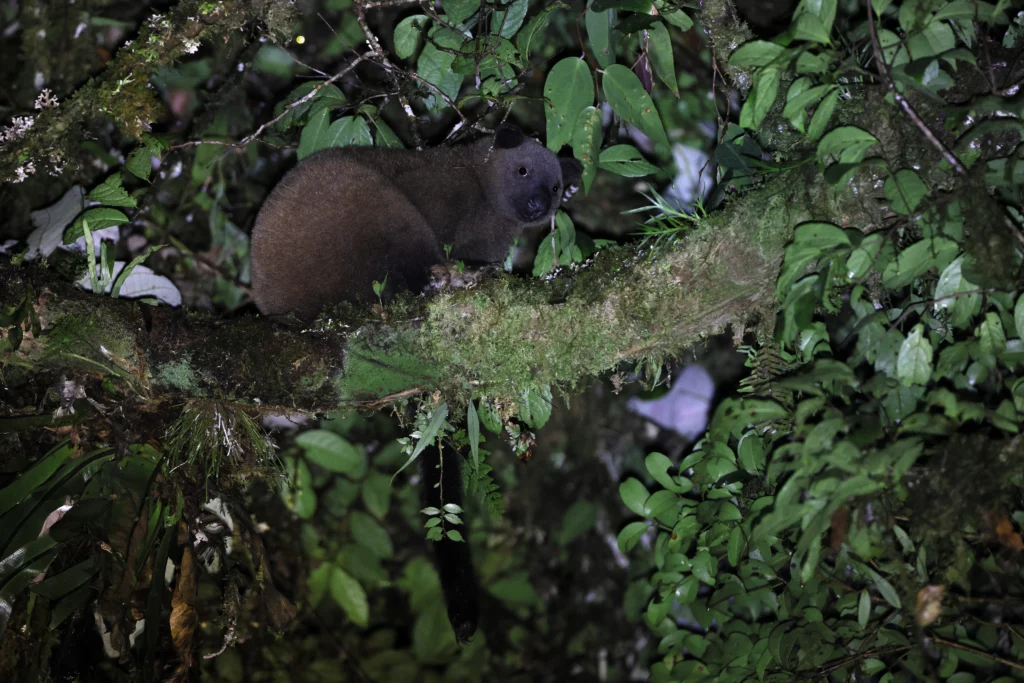
Doria’s Tree Kangaroo (Dendrolagus dorianus) is one of the largest tree kangaroos, a shaggy, dark species of the high mountain forests. On our Papua New Guinea mammal watching tour we search for it in the Owen Stanley Range.
Studied and protected, but not yet open to ecotourism
All tree kangaroos are difficult to see. But two of the rarest species are the focus of long-term research and community conservation programmes. In theory they could be seen, and a well-run ecotourism project could help protect them. So far, though, the people behind these programmes have not been able to set up a viable ecotourism project, for one reason or another.
Matschie’s (Huon) Tree Kangaroo
Matschie’s Tree Kangaroo (Dendrolagus matschiei), a beautiful chestnut-and-gold species, lives only on the Huon Peninsula of north-eastern Papua New Guinea and is Endangered. Since 1996 the Tree Kangaroo Conservation Program has studied it and worked with local landowners to protect it, leading to the creation of the YUS Conservation Area, where many communities have pledged to stop hunting, logging and mining. The animals are studied and monitored, but a stable ecotourism project has not yet been established there.
Tenkile and Golden-mantled Tree Kangaroo
The Tenkile or Scott’s Tree Kangaroo (Dendrolagus scottae) lives only in a small area of the Torricelli Mountains of north-western Papua New Guinea and is Critically Endangered. In the 1990s there may have been as few as 100 left. Thanks to the Tenkile Conservation Alliance and the hunting moratoriums agreed by local communities, the population has grown again to around 300 animals. The same work protects the Critically Endangered Weimang or Golden-mantled Tree Kangaroo (Dendrolagus pulcherrimus). Here too the animals are studied and protected, but a viable ecotourism project has not yet been set up.
Unstudied tree kangaroos
Other species are not the subject of any research or conservation programme at all. Without that groundwork, an ecotourism project could only happen if it were built from scratch, together with the communities that own the forest.
- Ifola Tree Kangaroo (Dendrolagus notatus): a Papua New Guinea species known from only a few mountain sites, such as Mt Sugarloaf.
- Goodfellow’s Tree Kangaroo (Dendrolagus goodfellowi): one of the most beautiful of all, red with golden stripes. Some communities have banned hunting on their land, but it remains very hard to find.
- Lowlands Tree Kangaroo (Dendrolagus spadix): a little-known species of remote forests in southern Papua New Guinea.
- Wondiwoi Tree Kangaroo (Dendrolagus mayri): known from a single specimen until it was photographed again in 2018. It is one of the rarest mammals in the world.
- Dingiso (Dendrolagus mbaiso) and Seri’s Tree Kangaroo (Dendrolagus stellarum): mountain species of the West Papua highlands. The Dingiso is sacred to the Moni people, who protect it.
Ecotourism: the door to conservation
For a tree kangaroo, a living animal in the forest has to be worth more to the people who own that forest than a dead one. That is why we believe that carefully managed ecotourism can be the door to successful conservation. We have seen it happen in Klalik, in West Papua, where a community ecotourism project built around the Western Long-beaked Echidna now brings more than 100 foreign visitors a year and gives the village a reason to protect its forest.
Tree kangaroos are rare, hard to see and localised. But everything is possible. Perhaps one day small, respectful groups will be able to visit the Huon Peninsula, the Torricelli Mountains or forests where no one has yet studied these animals, bringing new income to the communities that protect these animals and one more reason to keep their forests standing. If that day comes, we would love to be part of it.
Tree kangaroo FAQ
Where is the best place to see a tree kangaroo in the wild?
New Guinea. The mountains of the Vogelkop Peninsula in West Papua give you the chance of two species on one trip, and the highlands of Papua New Guinea are the place for Doria’s Tree Kangaroo. In Australia, Lumholtz’s Tree Kangaroo is fairly easy to see in the Atherton Tablelands of Queensland, and Bennett’s Tree Kangaroo can be found, with luck, in the Daintree.
How many species of tree kangaroo are there?
Around fourteen, depending on the taxonomy used. Two live in Australia and the rest in New Guinea.
Are tree kangaroos endangered?
Most species are threatened by hunting and forest loss. The Tenkile and the Golden-mantled Tree Kangaroo are Critically Endangered, Matschie’s Tree Kangaroo is Endangered, and the Vogelkop and Grizzled Tree Kangaroos are Vulnerable.
Can tree kangaroos hop?
Yes. They hop on the ground like other kangaroos, but they are also agile climbers that walk along branches and can leap between trees.
