
In May and June 2024 Carlos Bocos returned to West Papua’s Bird’s Head (Vogelkop) Peninsula to lead what was billed as the first dedicated group mammal watching tour of the region, run together with Martin Royle of Royle Safaris. The route followed the 2023 expedition with a few changes, and once again all three headline mammals were found: Vogelkop Tree Kangaroo, Grizzled Tree Kangaroo and Western Long-beaked Echidna.
Trip summary
- Dates: 23 May – 8 June 2024 (17 days)
- Route: Manokwari – Gunung Mupi (Arfak Mountains) – Manokwari – Klalik (near Sorong) – Waigeo Island (Raja Ampat)
- Leader: Carlos Bocos, with Martin Royle (Royle Safaris) and bat specialist Juliana Senawi
- Local teams: Hans Mandacan (Arfak Mountains) and Absalom Kalami (Klalik)
- Group: three guests
- Mammals: 51 species, including an undescribed Hipposideros leaf-nosed bat
Itinerary
- Day 1: arrival in Manokwari
- Days 2–7: Gunung Mupi, Arfak Mountains (camp at about 1,070 m)
- Day 8: Manokwari
- Days 9–14: Klalik community forest, near Sorong
- Days 15–16: Waigeo Island, Raja Ampat
- Day 17: Sorong and departure

Highlights
Gunung Mupi: two tree kangaroos and Stein’s Cuscus
Everyone in the group had long, close views of two Vogelkop Tree Kangaroos (Dendrolagus ursinus) near the Mupi settlement. A Grizzled Tree Kangaroo (D. inustus) took more work and was finally tracked down about three hours from camp. A push to the highest part of the mountain, at around 2,000 m and an area not visited in 2023, produced three Stein’s Cuscus (Phalanger vestitus). Ground Cuscus, Northern Common Cuscus, Arfak and Reclusive Ringtails, Feather-tailed Possum and Müller’s Three-striped Dasyure were also seen well on the mountain. Carlos also recorded his first New Guinea Jumping Mouse in the Arfaks.
Klalik: Western Long-beaked Echidna and the Pygmy Long-fingered Possum
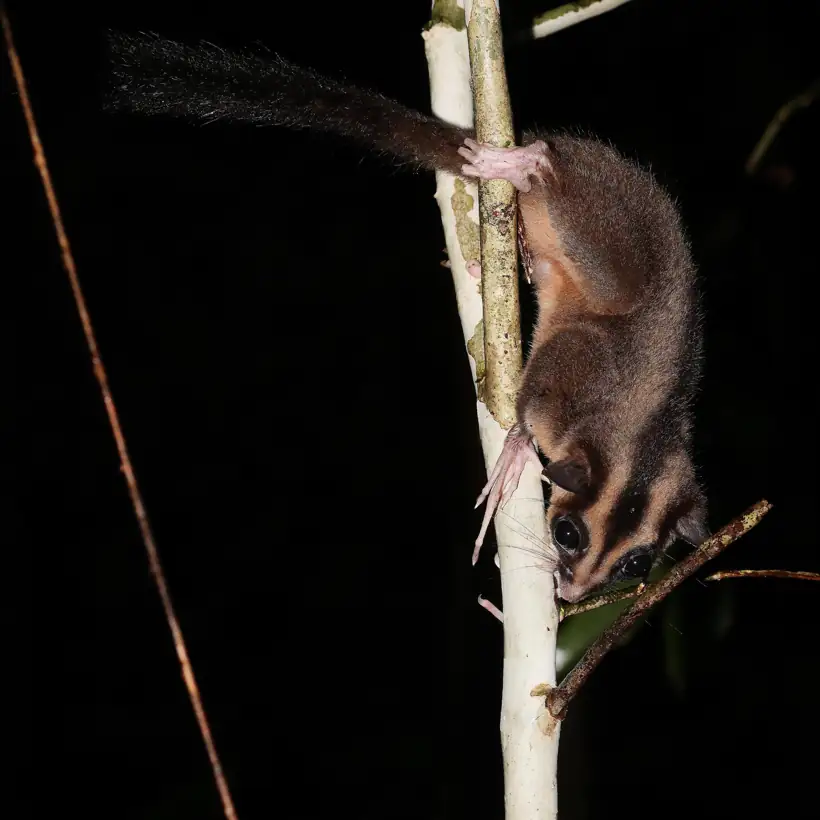
Klalik is the village where the community-run echidna project started after our 2023 expedition. Tourism income now gives the village a reason to protect the Critically Endangered Western Long-beaked Echidna (Zaglossus bruijnii) and its forest. The echidna was found on our fifth night, a year after Carlos first saw one there. On the same visit we watched a Pygmy Long-fingered Possum (Dactylonax kambuayai) in a large fruiting tree, close enough to see its extraordinary elongated finger. At the time we logged it as a Long-fingered Triok. It was in fact the same “Lazarus” species we had first photographed near Klalik in 2023, previously known only from fossils and thought to have been extinct for about 6,000 years. Its rediscovery was made public in early 2026 (read the full story). Klalik was also very good for bats and rodents. Species included the large undescribed Hipposideros found shortly after the 2023 trip, Maggie Taylor’s and Diadem Leaf-nosed Bats, two horseshoe bats, Rakali, Giant White-tailed Rat, Loria’s Pogonomys, Brown Dorcopsis and Lowland Ringtail.

A note on etiquette: this echidna is known from very few sites. Please keep your distance, never block its path and keep encounters short. Photographs are never worth disturbing a Critically Endangered animal.
Waigeo Island
The tour ended on Waigeo in Raja Ampat with about ten Waigeo Spotted Cuscus (Spilocuscus waigeou). The island’s caves held around 50 Temminck’s Trident Bats and Biak Roundleaf Bats, and Beaufort’s Bare-backed Fruit Bat, Large-eared Flying Fox and a pod of Spinner Dolphins were also recorded there.
Full mammal list (51 species)
Monotremes and marsupials
- Western Long-beaked Echidna (Zaglossus bruijnii)
- Vogelkop Tree Kangaroo (Dendrolagus ursinus)
- Grizzled Tree Kangaroo (Dendrolagus inustus)
- Brown Dorcopsis (Dorcopsis muelleri)
- Stein’s Cuscus (Phalanger vestitus)
- Northern Common Cuscus (Phalanger orientalis)
- Ground Cuscus (Phalanger gymnotis)
- Waigeo Spotted Cuscus (Spilocuscus waigeou)
- Arfak Ringtail (Pseudochirulus schlegeli)
- Reclusive Ringtail (Pseudochirops coronatus)
- Lowland Ringtail (Pseudochirulus canescens)
- Striped Possum (Dactylopsila trivirgata)
- Pygmy Long-fingered Possum (Dactylonax kambuayai)
- Feather-tailed Possum (Distoechurus pennatus)
- Müller’s Three-striped Dasyure (Myoictis melas)
- Common Echymipera (Echymipera kalubu)
Rodents
- New Guinea Jumping Mouse (Lorentzimys nouhuysi)
- Chestnut Tree Mouse (Pogonomys macrourus)
- Grey Tree Mouse (Pogonomys sylvestris)
- Loria’s Pogonomys (Pogonomys loriae)
- Bruijn’s Tree Mouse (Pogonomelomys bruijnii)
- Black-tailed Melomys (Melomys rufescens)
- Lowland Common Paramelomys (Paramelomys platyops)
- Rakali (Hydromys chrysogaster)
- Large New Guinea Spiny Rat (Rattus praetor)
- Giant White-tailed Rat (Uromys caudimaculatus)
Fruit bats
- Moluccan Bare-backed Fruit Bat (Dobsonia moluccensis)
- Beaufort’s Bare-backed Fruit Bat (Dobsonia beaufortii)
- Geoffroy’s Rousette (Rousettus amplexicaudatus)
- Common Blossom Bat (Syconycteris australis)
- Common Tube-nosed Fruit Bat (Nyctimene albiventer)
- Unstriped Tube-nosed Fruit Bat (Paranyctimene raptor)
- Great Flying Fox (Pteropus neohibernicus)
- Large-eared Flying Fox (Pteropus macrotis)
Insect-eating bats
- Undescribed leaf-nosed bat (Hipposideros sp. nov.)
- Fawn Leaf-nosed Bat (Hipposideros cervinus)
- Maggie Taylor’s Leaf-nosed Bat (Hipposideros maggietayloriae)
- Diadem Leaf-nosed Bat (Hipposideros diadema)
- Biak Roundleaf Bat (Hipposideros papua)
- Temminck’s Trident Bat (Aselliscus tricuspidatus)
- Large-eared Horseshoe Bat (Rhinolophus philippinensis)
- Broad-eared Horseshoe Bat (Rhinolophus euryotis)
- Beccari’s Sheath-tailed Bat (Emballonura beccarii)
- Raffray’s Sheath-tailed Bat (Emballonura raffrayana)
- Dark Sheath-tailed Bat (Mosia nigrescens)
- Little Bent-winged Bat (Miniopterus australis)
- Moluccan Myotis (Myotis moluccarum)
- Lesser Papuan Pipistrelle (Pipistrellus papuanus)
Others
- Spinner Dolphin (Stenella longirostris)
- Timor Deer (Rusa timorensis), introduced
- Wild Boar (Sus scrofa), introduced
Is this trip for you?
West Papua is one of the most rewarding places in the world to watch mammals, but it is demanding. The climb to Gunung Mupi takes 8–9 hours on steep, muddy trails, the accommodation in the forest is basic, and most of the mammal watching happens on long night walks. If that sounds like your kind of adventure, the rewards are mammals that very few people have ever seen.
Read the original reports on mammalwatching.com: Carlos Bocos’s species list and Royle Safaris’ day-by-day report. See also the West Papua 2023 expedition report and our West Papua tour page. Please contact us to hear about future departures.
