
The Western Long-beaked Echidna (Zaglossus bruijnii) is one of the most mysterious mammals on Earth: an egg-laying mammal, Critically Endangered, and found only in the forests of the Vogelkop (Bird’s Head) Peninsula of West Papua. Very few people have ever seen one alive in the wild, and the best place in the world to try is Klalik, the village where Mammalia’s story began.
What is the Western Long-beaked Echidna?
Echidnas and the platypus are the only living monotremes, the mammals that lay eggs. There are four species of echidna: the familiar Short-beaked Echidna of Australia and New Guinea, and three long-beaked echidnas found only in New Guinea. The Western Long-beaked Echidna is the type species of its genus. It has a long, down-curved snout and usually three claws on each foot, and it feeds mainly on earthworms, which it finds by probing the soft forest floor with its snout. The holes it leaves behind, known as nose pokes, are often the only sign that an echidna is around.
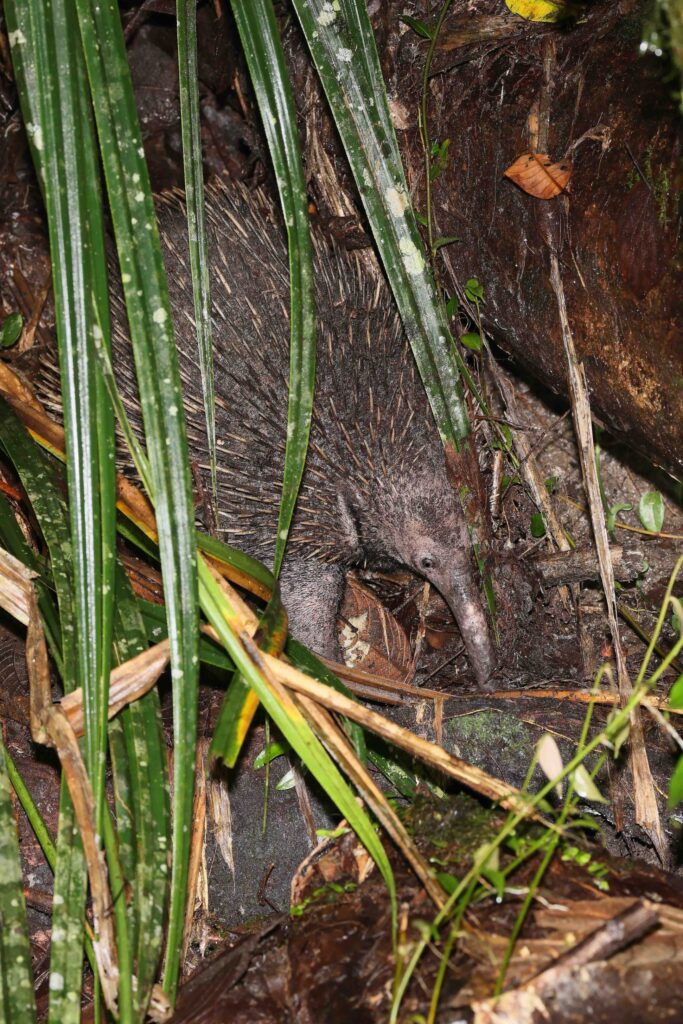
Why is it so hard to see?
It is nocturnal, lives at low densities in rugged forest and has been hunted for a long time. A study published in Oryx noted that before recent fieldwork there were only 11 records of the species on the Vogelkop, and only six verified records since the 1980s. It is listed as Critically Endangered on the IUCN Red List.
Klalik: the village of the echidna
Carlos Bocos was the first Westerner ever to visit Klalik, a small village in the forested limestone hills of the Vogelkop. Working with the community, he found that the Western Long-beaked Echidna could be seen reliably in the forests around the village, something almost nobody believed possible for one of the rarest mammals on Earth.
What followed is one of the great success stories of mammal watching. Klalik has become a community ecotourism project that now welcomes more than 100 foreign visitors every year, and everything revolves around the echidna. Villagers who once hunted it now guide visitors to it, and the income from mammal watchers gives the whole community a reason to protect its forest. As mammalwatching.com puts it, the site has “led to a thriving ecotourism project”. There is nothing quite like it anywhere else in New Guinea.
The echidna is also the spirit animal of Mammalia, which is why it is on our logo. Klalik is where our story began, and it is the heart of our West Papua mammal watching tour. It is also where, on a single night in 2023, the villagers brought us the Pygmy Long-fingered Possum, a species thought extinct for 6,000 years.
Where to see the Western Long-beaked Echidna
Recent records come from the forests of the Vogelkop Peninsula, including the hills around Klalik village in Sorong Regency, where researchers have also found its nose pokes. On our 2023 expedition the group saw one near Sorong, with the help of local guides. Our West Papua mammal watching tour visits the limestone hills of Klalik to search for it with the local community, along with tree kangaroos, cuscuses and the recently rediscovered Pygmy Long-fingered Possum. No one can guarantee a sighting of an animal this rare, but this is one of the very few places in the world where you have a real chance.
Mammal watching and conservation
Hunting and habitat loss are the main threats to the echidna. Every visit by mammal watchers who come specifically to see it shows the landowning communities that a living echidna in the forest is worth more than a hunted one.
Echidna FAQ
Where can I see a long-beaked echidna in the wild?
The best place in the world is Klalik, on the Vogelkop Peninsula of West Papua, where the community ecotourism project built around the Western Long-beaked Echidna gives visitors a real chance of seeing one. It is the highlight of our West Papua echidna and mammal watching tour.
How many species of echidna are there?
Four. The Short-beaked Echidna lives in Australia and New Guinea, and three long-beaked echidnas live only in New Guinea: the Western Long-beaked Echidna, the Eastern Long-beaked Echidna and Attenborough’s Long-beaked Echidna.
Is the Western Long-beaked Echidna the same as Attenborough’s Long-beaked Echidna?
No. Attenborough’s Long-beaked Echidna, which made headlines when it was filmed in the Cyclops Mountains, is a different species. The Western Long-beaked Echidna lives on the Vogelkop Peninsula, at the western end of New Guinea.
Is the Western Long-beaked Echidna endangered?
Yes. It is listed as Critically Endangered on the IUCN Red List, mainly because of hunting and habitat loss.
What does a long-beaked echidna eat?
Mainly earthworms, which it finds by probing the forest floor with its long snout.
Do echidnas lay eggs?
Yes. Echidnas and the platypus are monotremes, the only mammals that lay eggs.
