
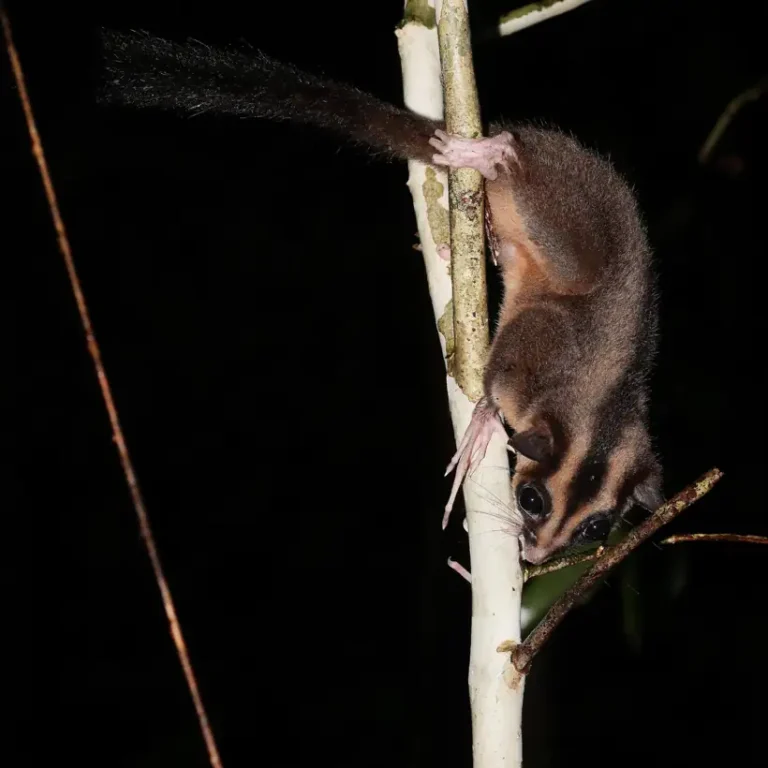
The Pygmy Long-fingered Possum (Dactylonax kambuayai) is one of the rarest and most extraordinary mammals on Earth. Known to science only from fossils and believed to have vanished around 6,000 years ago, it was found alive in the forests of the Vogelkop (Bird’s Head) Peninsula of West Papua during a mammal watching expedition led by Carlos Bocos in June 2023.
What is the Pygmy Long-fingered Possum?
It is the smallest of the striped possums, a small group of New Guinea and Australian marsupials with bold black-and-white stripes. Like its relatives, the trioks, it has an astonishing adaptation: one finger on each hand is about twice as long as the others. It uses it like a probe to hook insect larvae out of holes in rotten wood, filling the same niche that woodpeckers fill elsewhere in the world.
A Lazarus species rediscovered by mammal watchers
On a single night at Klalik village, on our June 2023 West Papua expedition, local villagers brought the group a small striped possum they called triok. Within moments everyone realised it was something special. A few weeks later, the mammalogists Kris Helgen and Tim Flannery confirmed what it was: Dactylonax kambuayai, a species thought to be extinct.
The discovery was published in March 2026 in a scientific paper led by Tim Flannery, co-authored by Carlos Bocos. It made headlines around the world, from The Guardian to the BBC. But as Jon Hall of mammalwatching.com pointed out on 6 March 2026, the official press release left out the people who made it possible: the mammal watchers on that trip and, above all, the Klalik community, whose knowledge of their forest was the key to the whole story. You can read Jon’s account, “New Pygmy Triok discovered after 6000 years (by us!)”, and our own West Papua 2023 expedition report.
Klalik is no ordinary village. Carlos Bocos was the first Westerner ever to visit it, and together with the community he turned it into a hugely successful ecotourism project built around the Western Long-beaked Echidna, which now welcomes more than 100 foreign visitors a year. The rediscovery of the Pygmy Long-fingered Possum is one more reason why this small community has become legendary among mammal watchers.
Where to see the Pygmy Long-fingered Possum
The species is only known from the lowland and hill forests of the Vogelkop Peninsula, in the Indonesian province of West Papua. It is nocturnal and very hard to find, and seeing it depends entirely on the help of local guides and landowners. Our West Papua mammal watching tour visits the forests around Klalik, where it was rediscovered, together with the community. No one can promise a sighting of an animal this rare, but there is no better place in the world to try.
Why it matters
The rediscovery shows how much remains unknown in New Guinea’s forests, and how much responsible mammal watching can contribute to science and conservation. Visits by mammal watchers bring income to the communities that own and protect the forest, giving them one more reason to keep it standing.
